Ir para o conteúdo
  • Press
  • Contact
  • en_US
  • pt_BR
Menu
  • en_US
  • pt_BR
  • About
    • who we are
    • CEBDS
    • Timeline
    • Vision, mission and principles
    • About WBCSD
    • who is part
    • Team
    • Governance
    • Work with us
    • Our Work
    • Thematic Chambers and Working Groups
    • Advocacy
    • Events
    • Initiatives
    • Training
  • Initiatives
    • Thematic Chambers and Working Groups
    • Climate
    • Energy
    • Biodiversity and Biotechnology
    • Sociobioeconomics
    • Social Impact
    • Agrifood Systems
    • Sustainable Finance
    • Water
    • Advocacy
    • Circular Economy
    • initiatives
    • Coalitions for Decarbonization
    • Net Zero Platform
    • Brazil of Solutions
    • Action Platform for Nature
    • Biodiversity Commitment
    • Water Security Commitment
    • UK Pact
    • Vision 2050
    • IBNBIO
    • Business Movement for the Amazon
  • Content Center
    • press
    • Clipping
    • releases
    • Spokespeople
    • Publications
    • Documents
    • News
    • Articles
  • News
  • Associates
  • Events
  • COP31
Pesquisar
Close this search box.
join
  • Social Impact, Institutional

CEBDS defends 'green recovery' post-pandemic in debate at the Environmental Parliamentary Front

  • Posted in 25/06/2020

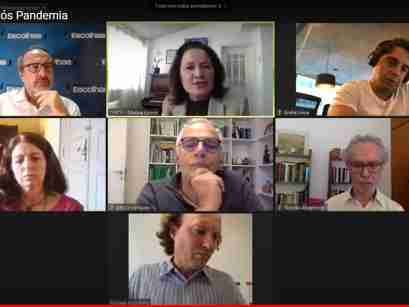
On Wednesday, June 24th, CEBDS President Marina Grossi participated in the Environmental Parliamentary Front, coordinated by Congressman Rodrigo Agostinho (PSB-SP). Adoption of a carbon market, combating illegal deforestation, the national solid waste law, and the replacement of fossil fuels with renewables were among the topics discussed in light of the post-COVID-19 pandemic recovery.

The Environmental Parliamentary Front, comprised of representatives and civil society, aims to develop public policies that promote sustainability by addressing issues important to Brazil and that are being discussed in the National Congress. The possibility of a "green recovery" after the pandemic and how to implement it is one such topic and was a central topic of discussion.

"Brazil can use this historic moment as the beginning of a more mature discussion about how we will proceed from now on regarding sustainability. We need to look to the future, and we need it to be transformative. We can't continue consuming the planet's resources at this rate. We need to advance the sustainability agenda, even though we know this is a challenging time for all of us," declared Agostinho.

Together with the government, CEBDS worked on an agenda with 10 proposals, with the drive sustainability as a generator of competitiveness for the country. Among these points are the universalization of basic sanitation, reduction of social inequality, and changes in the criteria for incentives and financing. "If investors continue to provide the same incentives, in the same way, to the same businesses, we won't have a more resilient economy," Marina stated, giving an example. "Saving airlines or the automotive sector, as was being done, won't be more resilient. When granting subsidies to companies, the government must demand cleaner operations," she emphasized.

Marina Grossi emphasized that a paradigm shift is underway, and after the pandemic, companies will be recognized for their empathy with their consumers, supply chains, and employees. At the same time, successful business leaders will be recognized for understanding the need to accelerate trends directly linked to a greener, cleaner economy.

"This acceleration toward a greener recovery involves simplifying the sustainability narrative and translating it to different audiences. The country has resources to invest, and we saw this happening during the pandemic. Now it's time to do the same with sustainability," he said.

Another important point that must be considered in the recovery is carbon pricing. CEBDS has already developed a proposal, which was presented to the Ministry of Economy, resulting from collaboration with business leaders from various sectors of the economy. "We spent eight months discussing with leaders of companies operating in the cleanest sector, which absorbs carbon from forests, to the largest emitter, which is oil and gas. We created a methodology to price carbon per ton, which can now be implemented," stated Marina Grossi.

Carbon pricing enables product traceability and greater consumer choice. "There's a significant shift in consumer habits in post-pandemic society. With the use of technology, we'll be able to track products and know exactly their environmental impact," Marina stated. "Companies are already ready to enter this more demanding market, and Brazil has no reason to shy away from it. Large companies can boost the entire production chain by using technology, combined with biodiversity and the bioeconomy, adding value to our products. We must look to future demand and where we can grow," she concluded.

The debate also included the participation of Ricardo Abramovay, Senior Professor of the Environmental Science Program at IEE/USP, Délcio Rodrigues, Executive Director of the ClimaInfo Institute, Celina Martins Ramalho, Managing Partner of Semear Consultoria and Sérgio Leitão, founder and executive director of the Escolhas Institute.

Share:

Sign up for our newsletter

Enter your email and receive our content. We respect the privacy of your information by not sharing it with anyone.

Related news

Check out the most current and relevant news to stay on top of what is being debated on the Sustainable Development agenda.

  • Institutional
  • 16/07/2026

Bunge is the newest member of CEBDS!

  • Institutional
  • 28/05/2026

Arca Sustentabilidade is the newest member of CEBDS!

  • Institutional
  • 30/04/2026

BHP is the newest member of CEBDS!

View more

Related publications

Want to go deeper into this subject? Check here other publications related to this same theme.

Trends Radar 2026
Institutional
  • Institutional
Learn more
  • March 16, 2026

Trends Radar 2026

Activity Report 2025
Institutional
  • Institutional
Learn more
  • January 27, 2026

Activity Report 2025

Establishing a New Paradigm: Metrics and Indicators to Boost Regenerative Agriculture in Brazil
Institutional, Agrifood Systems
  • Institutional, Agrifood Systems
Learn more
  • October 16, 2025

Establishing a New Paradigm: Metrics and Indicators to Boost Regenerative Agriculture in Brazil

Second Letter from the Special Envoy for the Business Sector
Institutional
  • Institutional
Learn more
  • October 13, 2025

Second Letter from the Special Envoy for the Business Sector

View more

related events

Check out our upcoming events related to this topic and join us to discuss and share best practices.

View more

THEME CHAMBERS
AND WORK GROUPS

Climate, Energy and Sustainable Finance

Biodiversity and Biotechnology

Amazon

Social Impact

Agrifood Systems

Water

Advocacy

Circular Economy


INITIATIVES

Agrifood Chains

Biodiversity Commitment

Water Security Commitment

COPs

IBNBIO

Business Movement for the Amazon

Action Platform for Nature

Net Zero Platform


ABOUT

CEBDS

Timeline

Vision, mission and principles

WBCSD

how we act

CEBDS advice

Team

Associated companies


CONTENTS

Publications

News

Events

Press


INTEGRITY

code of Conduct

Reporting Channel


CONTACT

+55 21 2483-2250

cebds@cebds.org

CEBDS RJ: São José Street, 40, 3rd Floor. Downtown, Rio de Janeiro, RJ.

CEBDS SP: R. Dr. Virgílio de Carvalho Pinto, 445, 3rd floor Pinheiros, São Paulo, SP.

FOLLOW US

Linkedin Facebook X-twitter youtube Instagram Spotify

BE A MEMBER

Join over 100 business groups working together to accelerate the transition to a sustainable future.

Read more

SUBSCRIBE TO THE NEWSLETTER

Enter your email and receive our content. With this, you authorize the capture, storage and use of data provided in campaigns to disseminate CEBDS publications, events and news by email. Unsubscribing can be requested at any time via descadastro@cebds.org.

Privacy Notice

Terms of use

Cookie Policy

CEBDS. All rights reserved. Copyright 2023© – Produced by Ludus and developed by webinhood.