In Baku, Azerbaijan, CEBDS represented the private sector at the launch of COP29, an event promoted by the Federal Government of Brazil, this Wednesday (13), to create the Brazil Platform for Climate Investments and Ecological Transformation (BIP), which aims to boost investments for the country's ecological and climate transition. The Platform was presented by Geraldo Alckmin, Vice President of Brazil, together with the Minister of Environment and Climate Change, Marina Silva, and the National Secretary for Climate Change of the MMA, Ana Toni.
BIP is an effort by Brazil to make the country's ecological transition a reality, with the goal of achieving an economic and social transition to a green economy. In this sense, the platform will operate with a focus on raising funds for the bioeconomy, industrial decarbonization and sustainable fuels, through public and private financing.

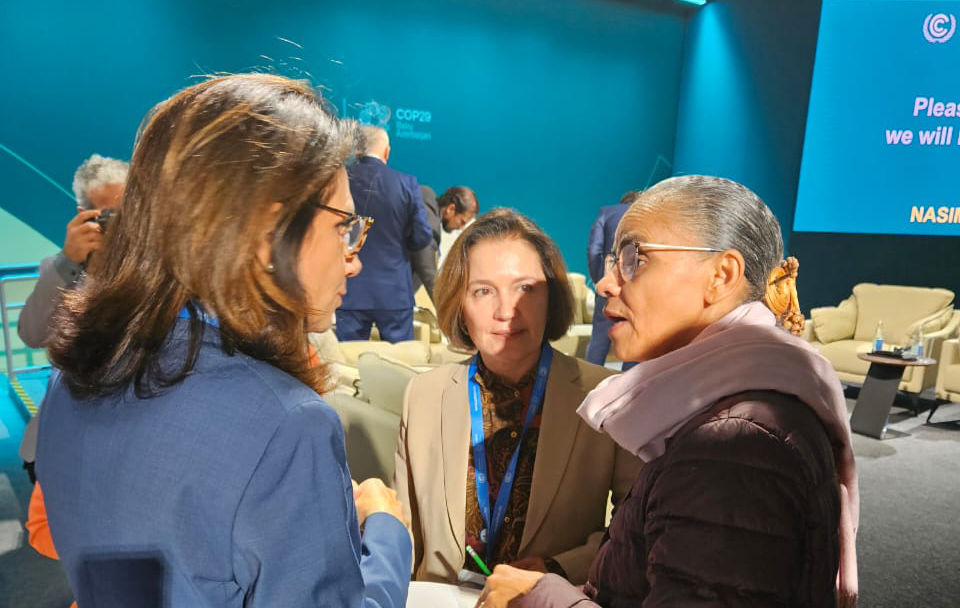
Ana Toni, National Secretary for Climate Change of the MMA; Marina Grossi, President of CEBDS and Marina Silva, Minister of Environment and Climate Change, during the event at COP29.
The initiatives that will receive incentives under the BIP are considered priorities for CEBDS, which launched, during COP16, a publication of Recommendations from the Brazilian Business Sector for the Development of the Bioeconomy, which was delivered to the Ministry of Development, Industry, Commerce and Services (MDIC). CEBDS also leads the consortium that provides technical support for the preparation of the National Sociobioeconomy Plan, within the scope of the National Strategy, together with the Brazil Climate, Forests and Agriculture Coalition, the Arapyaú Institute and The Nature Conservancy Brazil are also part of the initiative, which has financial support from UKPact.
What is the Bioeconomy?
The bioeconomy represents an innovative approach to ecological transition and sustainable development, prioritizing the use of renewable biological resources instead of fossil-based materials. Through the use of biomass, agricultural residues, and renewable forests, the bioeconomy fosters sectors such as energy, agriculture, and biotechnology, promoting a greener, low-carbon economy.
The importance of this economic model lies in its ability to generate economic development with less environmental impact, allowing countries around the world to move towards a production system that respects the limits of nature.
In addition to generating new business opportunities, the bioeconomy directly contributes to the preservation of biodiversity and the promotion of sustainable growth, transforming production practices and fostering environmental innovation.
#CEBDSnaCOP29
So that you can follow CEBDS' agenda and discussions at COP29 first hand, we have created the HUB #CEBDSnaCOP29, which will provide news from the business sector, publications, and other important details about events and CEBDS and associates' participation in the event. You can access it by clicking here.