
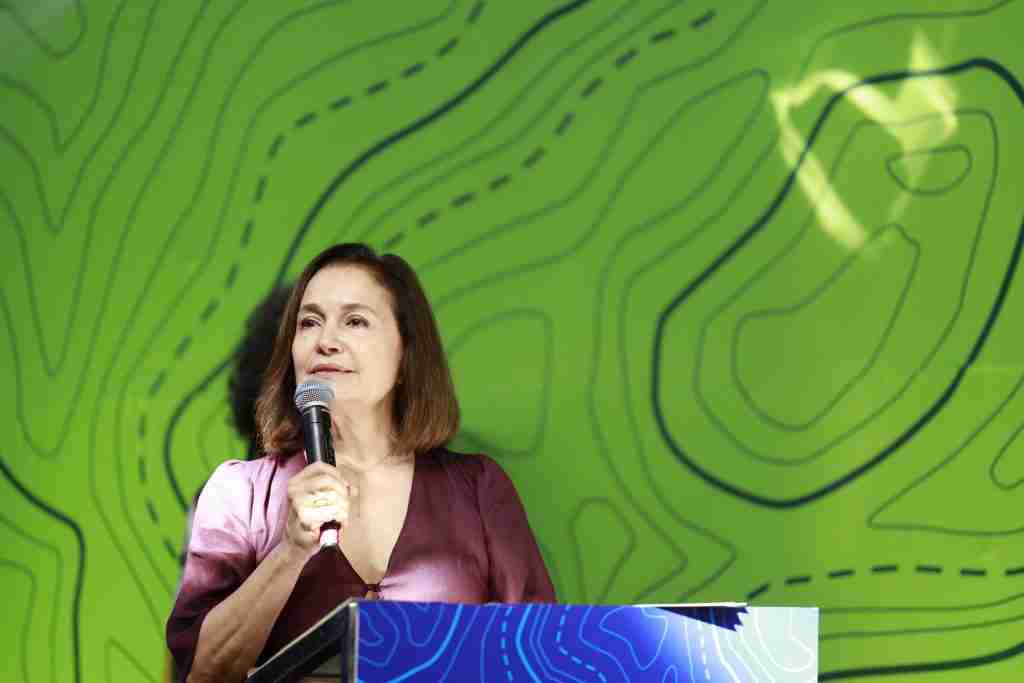
The president of CEBDS, Marina Grossi, released his first letter as Special Envoy for the Business Sector at COP30, highlighting the strategic role of companies in COP of implementationMarina emphasizes that the private sector will play a key role in transforming commitments into concrete, measurable, and high-impact actions, in partnership with governments, the financial sector, and civil society.
Check it out in full:
Letter from the Special Envoy for the Business Sector, Marina Grossi
Over the past three decades, multilateralism in the climate agenda has made significant progress in building consensus and an international legal framework that, while respecting the individualities of countries, aims to move humanity toward a prosperous, sustainable, and just global society. Today, we have a mature international system that offers us much greater security and the certainty that this is the unequivocal path forward.
COP30 is the COP of implementation. And, by its very nature, the business sector is destined to lead the transformation of goals and commitments into concrete actions—a process built by many hands. The private sector has much to contribute, propose, and deliver.
I was honored to be appointed by the COP30 President as Special Envoy for the Business Sector, with the mission of acting as a strategic bridge between businesses and the Conference leadership. My role is to facilitate the flow of information, articulate solutions, and identify levers with high potential for transformation, ensuring that the business sector, in Brazil and worldwide, contributes concretely, measurably, and in line with COP30's highest climate ambition.
The Brazilian COP30 Presidency, in its 7th letter, urgently calls on business leaders to join the world in Belém, a decisive moment to transform commitments into concrete implementation. The private sector is seen as an indispensable partner in the Climate Action Agenda, driving sustainable solutions, measurable results, and investments that will make climate action the greatest business opportunity of our time.
Guided, on a global level, by the recommendations of the Global Balance (the Global Stocktake – GST); at the national level, through Nationally Determined Contributions (NDCs); and at the corporate level, through corporate transition plans and sectoral strategies consolidated in coalitions and initiatives, we propose a broad, inclusive, and focused agenda to reach Belém with impactful deliveries.
On the action agenda, I am working specifically on objective 2, which focuses on accelerating zero- and low-emission technologies in sectors that are difficult to decarbonize, and also, across the board, on other crucial topics for the business sector, such as energy, agriculture, the bioeconomy, the carbon market, and financing.
To this end, we are working with the COP30 Presidency and Executive Board, respectively, André Corrêa do Lago and Ana Toni, as well as with the team of the Conference's High-Level Champion, Dan Ioschpe, on three fronts:
1. Prepare an assessment of the progress achieved in the last ten years, since the Paris Agreement, within the scope of the business sector's voluntary action agenda.
2. Consolidate successful technologies and solutions into platforms and case banks, allowing them to be viewed and replicated.
3. Structure high-impact solutions capable of guiding the main decarbonization and resilience paths for the next decade.
The COP30 objectives will only be achieved through a collective effort, catalyzing existing initiatives and valuing what is already underway in Brazil and around the world. I have been working to facilitate the participation of the business sector in the Activation Groups. To this end, I have been supporting active listening and the articulation of commitments, scalable solutions, investments, and policies. This way, we will be able to formalize impactful solutions with the potential for systemic transformation in the areas of energy, industry, agriculture, forests, finance, and other cross-cutting themes.
To this end, we are structuring an agenda to ensure that the voices of the business sector are heard and clearly conveyed to the COP30 Presidency. In addition to my work as head of the Brazilian Business Council for Sustainable Development (CEBDS), I have been promoting meetings with strategic partners such as the We Mean Business Coalition (WMBC), the World Business Council for Sustainable Development (WBCSD), Bloomberg, and SBCOP30, as well as working collaboratively with other Special Envoys and companies from different sectors.
The goal is to foster high-quality dialogue among diverse stakeholders, capable of generating concrete deliverables for the Solutions Acceleration Plans. We will hold strategic events—such as New York Climate Week, the Sustainable Peru Summit, the Innovation Summit in São Paulo, and the Pre-COP in Brasília—to deepen discussions and advance consensual proposals. We have already made progress on initiatives such as business coalitions in the areas of transportation, electricity, agriculture, minerals, and others currently under development, as well as pioneering methodologies in regenerative agriculture and the circular economy, advances in carbon markets, biofuels, and financial innovation. This is a national and international coordination effort that seeks not only to highlight good examples but, above all, to expand their scale and impact as concrete contributions to COP30 and beyond.
I count on the participation of the business sector, with its visionary spirit and ability to identify opportunities, to guide and accelerate solutions that make COP30 a milestone for global climate action. In partnership with governments, the financial system, and civil society, we will build a more prosperous, fair, and sustainable future.
Read the letter in English
Lea la carta en Spanish


