
Sectoral Coalition
Transport
Follow along as the six modes of transport — road,
rail, waterway, air, urban mobility
and transversality — they move forward together in
decarbonization.
Key Figures
90
levers decarbonization
mapped
levers decarbonization
mapped
POTENTIAL
DE 68%
MITIGATION of the sector's emissions by 2050,
Faced with a scenario without new measures
DE 68%
MITIGATION of the sector's emissions by 2050,
Faced with a scenario without new measures
120
institutions mobilized in 6 modes
institutions mobilized in 6 modes
From baseline to the expected scenario (2050)
Download the complete study Transport Coalition
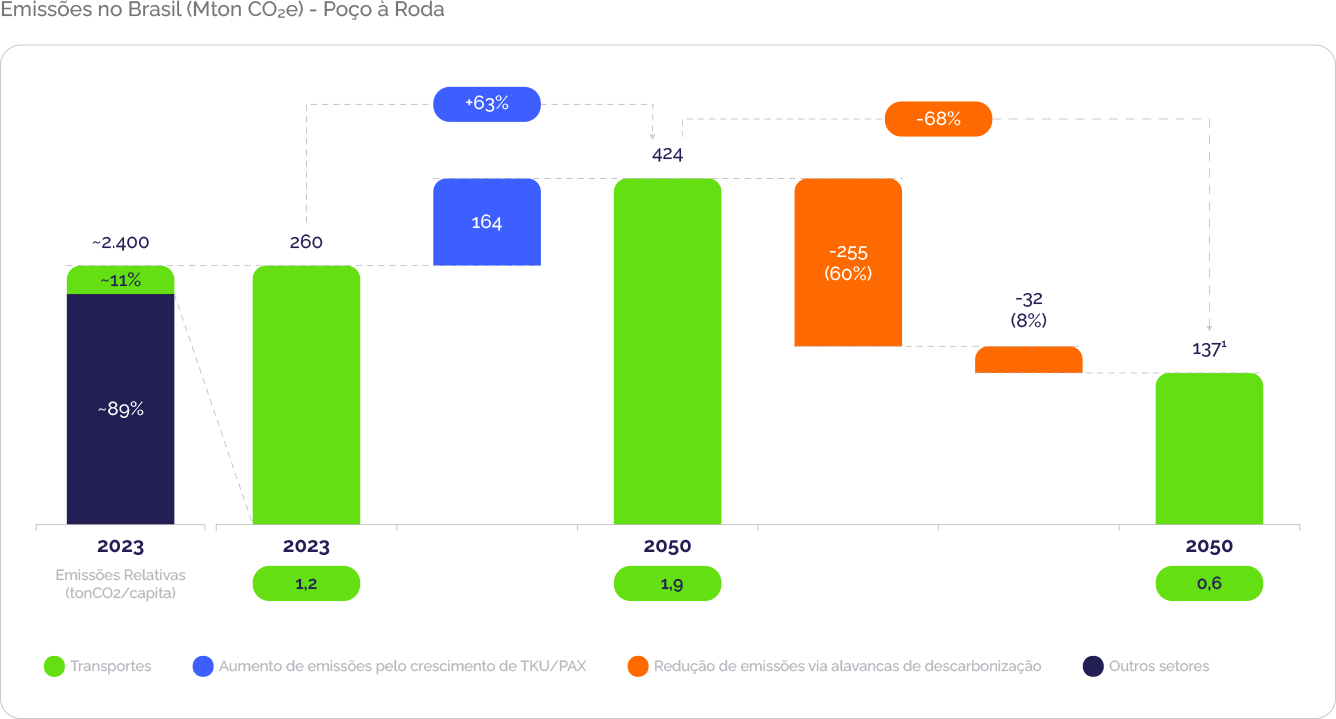
- 68% Potential for reduction
- 287 mtCO2e Emissions avoided
- 137 mtCO2e Residual emissions
- 2023 Baseline
Context
Transport responds
for approximately 11% of
Brazilian emissions. In
In 2023, the sector issued 260
millions of tons
CO₂ equivalent.
Without new measures, this
volume can grow 63%
and reach 424 million in
2050. The mapped solutions
The Coalition can change
this scenario and reduce in
68% projected emissions
by 2050.
Study objectives
- 1 Measure baseline of
emissions in scenario
without new measures:
424 mtCO2e in 2050 - 2 Define levers of
decarbonization: 90
levers for potential
complete and 15
prioritized for the agenda
short term - 3 Accelerate implementation
and to quantify the progress
of the Coalition
Ambition 2050
287 mtCO₂e emissions avoided
Equivalent to ~110% of current emissions from the sector
(in 2023)
(in 2023)
