
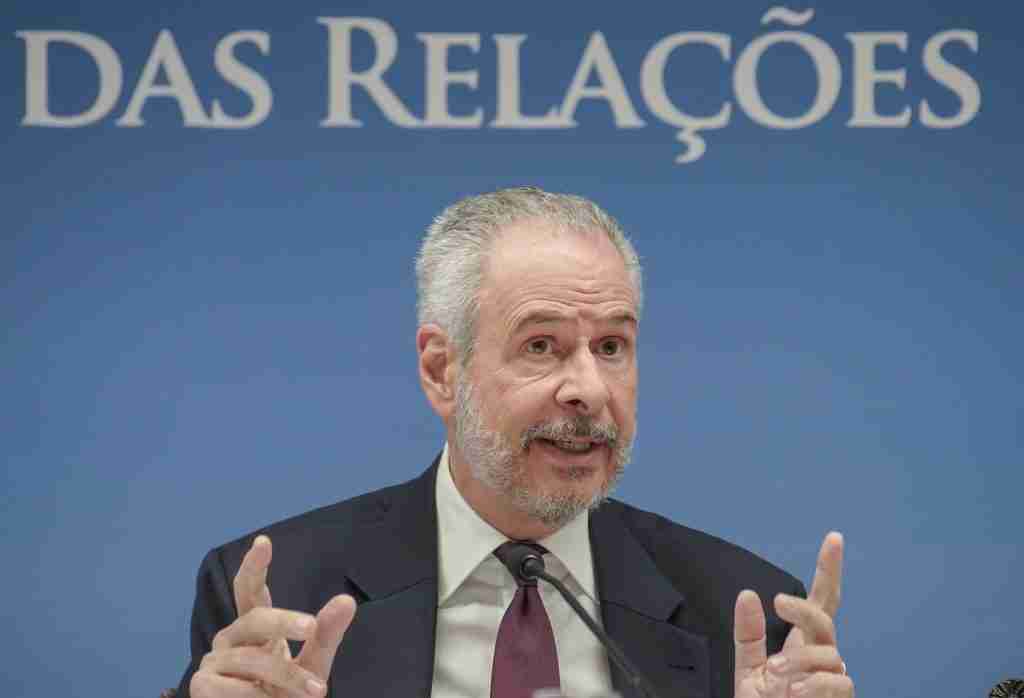
On the official COP30 website, the fifth letter from COP30 President André Corrêa do Lago is addressed to the people and the importance of unity against the climate challenge.
Unlike other letters, the document released this Tuesday (12) aims to speak directly to individuals engaged or affected by climate change, talking about the human role in combating climate change.
Check out the letter in full:
Fifth Letter from the COP30 Presidency
August 12, 2025
Dear Friends,
In this fifth letter to the international community, the COP30 Presidency recalls the founding spirit of the United Nations: we are a community of peoples before we are a community of nations. In this letter, we invite the international community to remember that climate action is not just a scientific or technical challenge—it is, above all, a human challenge.
This is a letter to the people—to the lived experiences, agency, and leadership of people on the front lines of climate change, especially those in vulnerable situations. They are not passive victims of climate change, but living leaders of care, resilience, and regeneration. Their role as guardians of land, culture, knowledge, and solidarity is not a legacy of the past, but an example of more harmonious ways of relating to Nature as a model for a shared future.
For all those historically marginalized, displaced, or silenced, COP30 must be a turning point for them to be recognized as both essential actors and rights holders in the global climate response.
A New Invitation: Climate Action Begins and Ends with People
The COP30 Presidency calls on the international community to honor our memory. We are the people of the United Nations, resolved to save future generations from the scourge of emerging risks. We know, deep in our souls and through our institutions, that we belong together. We find meaning in honoring our ancestors and safeguarding the future of our children. We find purpose in joining forces and combining our efforts for shared protection, justice, and prosperity.
We are people in families, cities, and countries. We are people in businesses, markets, and finance. We are people of nature, ecosystems, and the planet. In a changing climate, human experiences of loss and coexistence are not abstract. They are geographic, corporeal, and sacred. They transform into memories, grief, and courage. Let us honor them at COP30.
For too long, climate action has been framed as a technological issue, one of metrics and timelines. But at its core, it's a story about who we are, what we remember, how we care, and what we want to preserve and create. We need to reclaim climate action as a human act, as an act of profound responsibility, reciprocity, and solidarity.
As climate change emerges as a global crisis, human connections at the local level also emerge as our most powerful resource. Now is the time to confront global warming by putting people at the center of our response. Now is the time to demonstrate humanity—individually and collectively.
Ultimately, the climate crisis means giving urgency to people's needs and hopes. Mitigation, adaptation, financing, technology, and training imply, first and foremost, addressing structural inequalities, ending hunger, and combating poverty, promoting sustainable development, human rights, and equality, including racial and gender equality. The climate fight is about quality of life, physical integrity, health, property, housing, freedom, water, food, work, social security, culture, and education. It is about family, parenting, and neighborhoods.
It's time to remember that climate justice begins with people. That territory is not just land, but memory, identity, governance, and future. That ancestry is not the past, but a guiding intelligence. That ancestral knowledge is vital to humanity's survival and flourishing. That memory is infrastructure, and that storytelling is a form of climate action—capable of connecting generations, building belonging, and restoring trust. That care is a form of power, to be integrated into how we plan, finance, govern, and adapt.
As the adverse effects of climate change increasingly affect individuals and communities around the world, we know that the impacts are felt most acutely by those already in vulnerable situations, whether due to geography, poverty, gender, age, race, ethnicity, membership of indigenous peoples or minorities, nationality or social origin, birth, or disability.
And while the climate crisis has disproportionately impacted those least responsible for the problem, these people demonstrate exceptional leadership:
- Women and girls are persevering in social cohesion, sustaining the fabric of community resilience and moving socioeconomic thinking toward a new paradigm of sustainability.
- Young people and children are reminding us that time is not abstract – it is urgent, lived, and theirs.
- Indigenous Peoples protect a large part of the world's biodiversity – their stewardship of the territory goes far beyond conservation; it is cosmology, knowledge, memory, governance and survival.
- Traditional, rural and coastal communities carry ancestral wisdom of the land, waters and seas, transmitted through calloused hands and whispered melodies.
- Distinct groups, such as those of African descent, transform territories into beacons of collective creation, cultural affirmation and resistance.
- Communities on the outskirts of cities combine orality and mobilization with digital technologies, redefining urban life, leveraging cultural wealth and innovating in territorial planning, preparation and regeneration.
- Elderly people, ethnic minorities, migrants, people with disabilities and those living in poverty have created models of mutual care and radical inclusion that climate policy has yet to fully grasp.
People—and women, in particular—who resist, confront, and overcome overlapping inequalities teach us how to convert injustice into powerful energy for resilience and transformation, inspiring examples of climate response—action, not reaction. Similar leadership is exercised daily by workers most exposed to the health impacts of climate change, working in fields such as agriculture, construction, manufacturing, transportation, and public safety—especially those who work outdoors, in overheated indoor environments, or on the front lines of emergency response.
More than limited by their vulnerability, these people are masters of vitality, wisdom, and creativity. They are not merely peripheral due to their geography—they are protagonists on the front lines of mitigation, adaptation, and resource sharing. They are agents of change, bearers of unique perspectives and solutions.
The COP30 Presidency humbly bows before all those who lead by example. We recognize you not because you need recognition, but because we need your courage—to overcome our fear of loss, change, and lack of control. We need your courage to teach us that genuine leadership comes not from authority, but from care and affection.
The COP30 Presidency launches a new invitation: let's make climate action begin and end with people.
Bringing COP30 to the heart of the Amazon means giving space to the vulnerable and marginalized as genuine leaders, who make courageous decisions every day – and who must now occupy the center of global decision-making.
Bringing people to the center of COP30
As we center our climate response on people, we invite the international community to join forces with the Brazilian presidency to bring people to the center of COP30, through concrete actions and measurable positive impacts across all four of its action fronts – Global Mobilization; Action Agenda; formal UNFCCC negotiations; and the Leaders' Summit.
Global mobilization: The COP30 Presidency has learned a lot from our Special Envoys, the Presidency's Youth Climate Champion, Marcele Oliveira, and the People's Circle, who have been invaluable allies in connecting the COP to people's realities. Putting people at the center of climate action and reclaiming our sense of agency represent the very spirit of the Global Mutirão, around which we invited the international community to unite in my first and second letters.
Formal UNFCCC negotiations: People are at the heart of the formal negotiations we referred to in our third letter, including the Global Goal on Adaptation (GGA) indicators under the Emirates-Bethlehem Work Programme, the Emirates Dialogue on the implementation of the results of the Global Stocktake (GST) and the UAE Just Transition Work Programme (JTWP) – in addition to our joint work on topics such as the new Gender Action Plan, the Local Communities and Indigenous Peoples Platform (LCIPP) and loss and damage.
Action AgendaFrom promoting human and social development to building resilience in cities and mobilizing catalysts and accelerators, such as finance and technology, each of the six axes of the Action Agenda we unveiled in our fourth letter offers pathways to implementing the care, dignity, and leadership we honor in this fifth letter. By aligning people-centered realities with the implementation of the GST in the Action Agenda, we reinforce the legitimacy and accountability of our climate efforts—transforming memory into metrics and solidarity into systems transformation. Contemporaneous with the 2030 Agenda for Sustainable Development, the Action Agenda also offers a unique opportunity for COP30 to support the Sustainable Development Goals (SDGs) with climate solutions that promote climate justice, combat hunger and poverty, and address structural inequalities, including those based on gender, race, and socioeconomic conditions.
Leaders Summit: At the COP30 Leaders' Summit, which we will discuss in a future letter, we will invite leaders to unite in a genuine parliamentary debate to find concrete solutions that connect the climate regime to real life and people's daily lives.
The critical moment we live in demands that we respond with courage. As we strengthen multilateralism and accelerate implementation of the Paris Agreement, people must be the purpose behind every Nationally Determined Contribution (NDC), National Adaptation Plan (NAP), and Biennial Transparency Report (BTR). People must be the purpose behind climate finance and trade. People must be the purpose behind the global nature and energy transition agendas. The COP30 Presidency is determined to do everything in its power to leverage unity and cooperation around COP30 priorities for the sake of multilateralism, people, and accelerated implementation.
To protect people in a context where climate urgency interacts with heightened geopolitical and socioeconomic challenges, the COP30 Presidency expects us to remain guided by three interconnected priorities: (1) Strengthen multilateralism and the climate regime under the UNFCCC, (2) Connect the climate regime to people's real lives, and (3) Accelerate the implementation of the Paris Agreement, stimulating actions and structural adjustments in all institutions that can contribute to this goal.
A Renewed Invitation: Change by Choice – Together
The COP30 Presidency issues a renewed invitation to the international community: let's change by choice, together. Let's not allow fear and the impacts of climate change to define people's choices.
Beyond pain and suffering, the climate challenge offers an opportunity for evolution. Overcoming climate change can be a process of transitioning from a fragmented model of extraction, domination, and territorialism to an integrative model of symbiosis, mutual belonging, and stronger human bonds.
Like all transitions, the climate transition involves change and loss toward greater gain. As symbolic beings, we humans need rituals to process grief for what we've left behind while also embracing the new.
The COP30 Presidency invites the international community to make Belém a rite of passage to soberly mark and celebrate our transition to a more promising and prosperous future. First, a rite in which we allow ourselves to mourn the loss of those who have left us due to extreme weather events—from floods in Brazil and India to heat waves in Spain and Japan. Alongside loss and damage, we can use COP30 to collectively mourn a development model that promised prosperity in the past but no longer offers hope for the future.
Second, as a rite of passage to honor memory, COP30 can be a moment to safeguard our human essence—the essential that must be preserved as we metamorphose into the new. Our essence resides in non-negotiable human values: empathy, compassion, and solidarity.
Third, by remembering who we essentially are and what we value, COP30 can offer a platform for us to build together, starting now, the future we want. The COP30 global mobilization, the Leaders' Summit, the formal negotiation process, and the Action Agenda are all blank slates for co-creation and arenas for collaboration.
In memory, resistance, and imagination, may COP30 be the gathering where formal authority walks hand in hand with genuine leadership. Where we, the peoples of Earth, can come together to remember what it means to belong to the planet and to each other. Where climate action isn't limited to institutions alone, but begins and ends with people. Let us move forward decisively to change by choice, together.
André Aranha Correa do Lago
Designated President of COP30


