
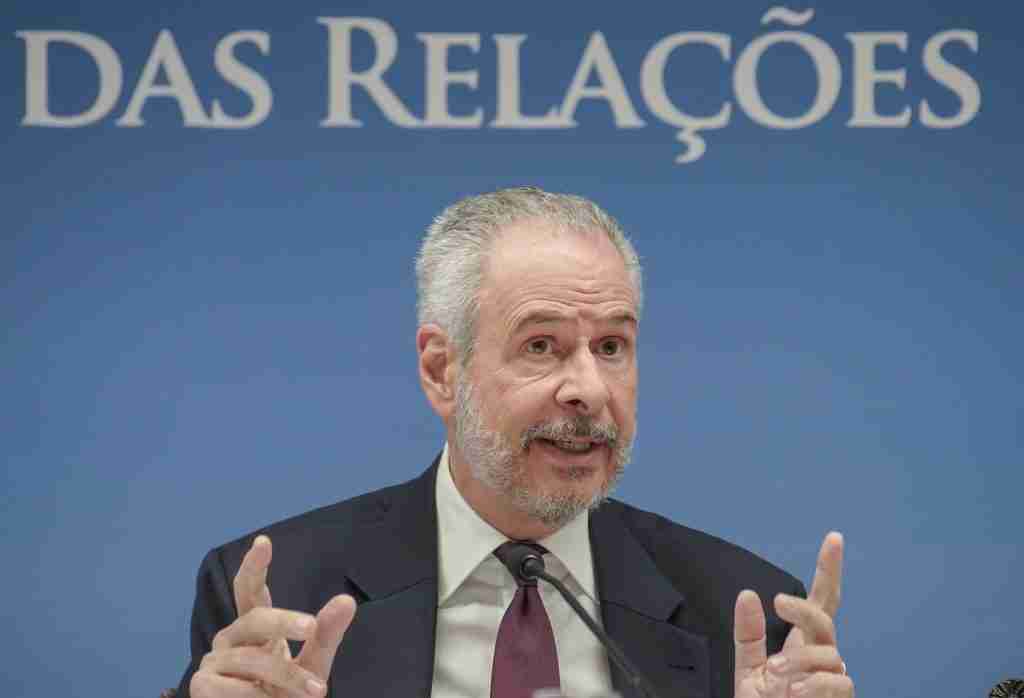
The second letter from André Corrêa do Lago highlights points that are guiding Brazil's actions at the event, and calls on the world to fight climate change.
The document was launched this Thursday (08), and addresses the four pillars of the conference, Brazil's role and importance in the event, and calls on other countries to combat the causes and effects of climate change.
Check out the letter in full:
Second letter from the COP30 Presidency
Dear friends,
The signs of human-caused climate change have reached new heights since I published my first letter to the international community in March. The World Meteorological Organization’s (WMO) State of the Global Climate report confirmed that 2024 was the hottest year on record, with atmospheric carbon dioxide concentrations reaching their highest level in 800,000 years. Clear signs of a global crisis are emerging in rising ocean temperatures, declining sea ice cover and glacier mass, and rising sea levels.
With this second letter, the Brazilian presidency of the 30th session of the Conference of the Parties (COP30) of the United Nations Framework Convention on Climate Change (UNFCCC) moves from vision to action, calling on the international community to mobilize in the face of the climate emergency.
At this time of serious geopolitical, socioeconomic and environmental challenges, we must unite to (1) strengthen multilateralism and the climate change regime under the UNFCCC; (2) connect the climate regime to people's real lives; and (3) accelerate the implementation of the Paris Agreement, by encouraging actions and structural adjustments in all institutions that can contribute to this.
United, we can reverse the dangerous trend toward successive, domino-like systemic collapses. Together, we can support each other, averting a potentially devastating chain reaction and instead triggering “chain actions” toward exponential low-carbon, climate-resilient solutions. While the challenge is immense, we must rise up and confront it.
This must be the moment when nations and generations come together, combining the wisdom, patience and maturity of the most experienced with the enthusiasm, idealism and creativity of the youth.
In order to contribute to a turning point in our climate fight, I will publish a series of communications to promote a global effort around four fronts of action with a view to COP30 and beyond:
(i) a process of global mobilization;
(ii) the Action Agenda;
(iii) the formal UNFCCC negotiations – from the 62nd session of the Subsidiary Bodies for Scientific and Technological Advice (SBSTA) and Implementation (SBI) in June to COP30 in November;
(iv) the Leaders’ Summit.
Throughout the year, the COP30 Presidency will announce specific plans on four fronts of action. In this letter, I propose plans around “(i)”: our global mobilization begins now.
The Presidency will work closely with the High Level Champion, Dan Ioschpe, the Youth Champion, Marcele Oliveira, and special envoys, who will act as “levers” on the global mobilization front.
Global Mobilization, taking forward the “Global Mobilization”
In addition to the formal UNFCCC negotiations, the Agenda for Action and the Leaders’ Summit, the COP30 Presidency has embarked on a pioneering experiment that aims to trigger an unprecedented global mobilization against climate change, based on the proliferation of autonomous initiatives around the world. This mobilization – the “Global Task Force” – aims to drive action and ambition, creating the conditions for a turning point in our fight against climate change. The Global Task Force will seek to spark a movement to mobilize humanity in its transition to the future, supported by a global framework capable of integrating local actions.
The COP30 Presidency invites stakeholders to join in the collective creation of this global framework within which everyone can act to strengthen the task force as a global movement. This collective creation mission will begin at the first UNFCCC Climate Week in 2025 (Panama City, May 19-23), so that stakeholders at all levels and latitudes can contribute whatever they have to offer to our common climate struggle.
The COP30 Presidency extends an open invitation to all members of the human family: come as you are and as you can be. Within the framework of the Global Task Force, everyone will be welcomed, regardless of their level of engagement, expertise and perspective.
The Global Mutirão is much more than a joint effort or a task force. This form of mobilization — from the bottom up, without hierarchy — emerges spontaneously and organically when there is an urgent need that has not yet been met. Mirroring real-life experiences — whether in indigenous communities, urban peripheral communities of African descent, or other collectives — the Global Mutirão framework will welcome individuals and organizations to present “self-determined contributions,” using their experience, time, and/or resources to sustainably address climate challenges through interventions and positive impacts at all levels — from the local to the global. Analogous to the “nationally determined contributions” (NDCs) of the Paris Agreement, “self-determined contributions” will function as bottom-up actions.
Rather than involving promises to be fulfilled in the future, contributions to the mutirão should translate into initiatives that have actually been carried out, are underway, or are about to happen. For example, a group of farmers adopting regenerative practices with local support; youth-led projects installing solar panels in underserved communities; coastal cities organizing mangrove restoration brigades; technology companies forming coalitions to decarbonize data centers; Afro-descendant communities creating climate awareness programs for cities. Although diverse, these actions are united by a common spirit: they are collective, immediate, and autonomous contributions toward a sustainable future.
This great undertaking is based on “learning by doing”. To put the Global Task Force into practice, it requires a new approach: one in which the COP30 Presidency acts as a vehicle to inspire the capacity to act in others. Everyone from all walks of life – governments, civil society, the private sector, individuals – is invited to take the lead in achieving concrete results through autonomous action. The spirit of the Task Force is to join hands and take responsibility for positive change, rather than simply advocating, demanding and waiting. As Mahatma Gandhi famously said, “Be the change you wish to see in the world”.
Circles of wisdom for the metamorphosis of the planet
To further broaden the global mobilization against climate change, the COP30 Presidency recently launched four Leadership Circles: (i) the “Circle of COP Presidents”, (ii) the “Circle of Peoples”, (iii) the “Circle of Finance Ministers” and (iv) the “Global Ethical Balance Circle”. Like waves forming and merging into a relentless current, these circles will flow together, channeling collective wisdom to generate renewal and evolution.
Chaired by Laurent Fabius, President of COP21, which led to the adoption of the historic Paris Agreement in 2015, the COP Presidents’ Circle will bring together the leadership of every COP Presidency since then. This assembly will draw on their experience and insights to collectively advise the COP30 Presidency on ways the international community can strengthen global climate governance and accelerate the implementation of the Paris Agreement, while preserving its integrity and the legacy of these past years.
The “People’s Circle”, led by the Minister for Indigenous Peoples, Sônia Guajajara, will amplify the voices of indigenous peoples, traditional communities and Afro-descendant groups. Complementing the existing participatory platforms under the UNFCCC, this circle aims to advise the COP30 Presidency on ways to deepen global recognition and integration of traditional knowledge, practices and solutions into the overall climate policy discourse, ensuring that these critical perspectives inform and enhance international climate solutions, respecting their rights and combating racism and environmental inequalities.
The “Circle of Finance Ministers”, chaired by Minister Fernando Haddad, will seek to provide advice to the COP30 Presidency from an implementation and policy-making perspective on climate finance issues. Regularly bringing together finance ministers, financial experts, private sector representatives and civil society leaders, this circle will contribute strategic insight and implementable recommendations.
Under the guidance of the President of the Republic, Luiz Inácio Lula da Silva, and the Secretary-General of the United Nations, António Guterres, the “Global Ethical Balance Circle” will be led by the Minister of Environment and Climate Change, Marina Silva. Its mission will be to raise global awareness through inclusive dialogues in different regions, bringing together political, intellectual, academic, cultural and religious leaders, as well as voices from all sectors of society. Inspired by the legacy of Pope Francis, whose passing we mourn, the new Presidency sees Laudato Si’ (2015) as an ethical compass and a pragmatic guide for this global mobilization.
As prototypes of proactive governance, the four Leadership Circles can create waves of powerful ideas to strengthen the transformational potential of the Global Task Force.
Prepare yourself now for the unexpected, using science and ancient wisdom
As part of this global mobilization, the COP30 Presidency relies on the use of ancient wisdom and science to find new solutions in climate governance and climate action—including to prepare for an unpredictable future. British physicist and cosmologist Stephen Hawking called the 21st century “the century of complexity.” As an issue related to complex systems, climate change is a clear example of how complexity will increasingly define risks and opportunities in the coming decades.
Although we are now approaching the second quarter of the 21st century, we still rely on hierarchical models of the past, based on linear thinking; however, the challenges that befall us are complex and require systemic thinking, decentralization and distributed action. Our climate struggle may be suffering from “Past War Syndrome” – the tendency to face new crises with outdated strategies that ignore broader transformations in science, technology and political, economic and social realities. Although most existing governance institutions were designed and developed before global warming became the reality we face today, climate change will increasingly impose itself as a supervening and disruptive force on political and socioeconomic agendas.
It is high time we began to reflect on ways to strengthen global governance to exponentially accelerate the implementation of the Paris Agreement and support the UNFCCC decision-making process and mechanisms, from an intergenerational perspective. Climate change requires us to innovate towards new models for new challenges, as past assumptions quickly become obsolete in an environment that changes exponentially, and in which solutions emerge exponentially, including in terms of both evolution and impact. Tropical forests and the Internet stand out as inspiring cases in which complexity and diversity are now contributing to dynamism and adaptability.
In parallel with the promotion of immediate and widespread climate action through the “Global Action Plan”, our global mobilization aims to encourage the international community to anticipate risks and reflect on current governance systems – and to assess whether our national and multilateral instruments are prepared for the serious dangers that science warns us about. The COP30 Presidency invites community leaders, academics and scientists to explore the best available science and ancestral wisdom to identify how our institutions can become exponentially more effective in deploying solutions and more flexible in responding to the unpredictable, including through agile, iterative and adaptive capacities to address the climate crisis.
Embracing complexity to enhance cooperation
As so many experts have pointed out, the climate challenge requires leaders to coordinate efforts globally to make a difference locally. As they navigate uncertainty, they need to look further afield to anticipate and implement governance that is sustainable in the long term, capable of evolving and constantly testing assumptions. Our global climate cooperation must not only work in the reality of 2025, but also be ready to evolve and meet the realities of 2030, 2035 and 2050. In such a complex, rapidly changing and deeply uncertain context, the task is particularly daunting – and no less imperative.
By incorporating complexity, improved institutions and polycentric approaches can draw on experimentalism and scenario planning to channel systems feedback loops, leverage tipping points and network effects, and create emergent and self-organizing behaviors for systemic resilience and exponential diffusion of solutions, while responding to bottlenecks and delays.
Building on the debate launched by President Lula last year at the G20, and looking to the long term, the international community should explore how climate cooperation can be better equipped to accelerate the implementation of the Paris Agreement and the COP decisions, by bringing together currently fragmented efforts. Leaving behind old bureaucratic models that compromise speed and scale, debates at the UN General Assembly could explore innovative governance approaches to equip international cooperation with resources for the rapid sharing of data, knowledge and intelligence, as well as for leveraging networks, pooling efforts and articulating resources, processes, mechanisms and actors within and outside the UN. Innovations in international cooperation could focus on “aligning” actors and efforts that are currently dispersed, while preserving and even strengthening the role of the UNFCCC in negotiating, coordinating and creating rules on climate change in terms of international law.
Without duplicating the role of the UNFCCC, updated global governance can also combine nascent technologies and ancient wisdom to introduce a whole new infrastructure of cooperation focused on collective intelligence and exponential results in climate implementation – exactly what we need to win the race against the first climate-induced tipping point. More systemic approaches could also help vulnerable countries in emergencies, connecting the work of the Santiago network, the Warsaw International Mechanism and the Loss and Damage Fund with the Multilateral Development Banks, the International Financial Institutions and the Early Warning for All initiative.
Systems thinking in climate action also offers the possibility of buying time against global warming in the short term. In terms of sequence of actions, we can focus global efforts on leveraging the role of climate regulators and promoting massive efforts to remove greenhouse gases from the atmosphere. Restoring forests, restoring degraded land for agriculture and enhancing coastal ecosystems can be powerful tools for both removal and resilience, while the oceans are some of the greatest allies in the fight against climate change, as the world’s largest “carbon sink”. The COP30 Presidency looks forward to working closely with Costa Rica and France in view of the 3rd United Nations Conference on the Oceans (UNOC3, Nice, 9-13 June 2025).
Systemic implementation also favors the integration of different complementary solutions that could emerge as ecosystems of exchange, interaction, and symbiosis. Traditional and ancestral knowledge, digital technology, and biotechnology can help fill the gaps in speed, scale, and resilience in ways that our governance is still slow to incorporate and scale. As an example of untapped potential, the Digital Public Infrastructure (DPI), presented under India’s leadership at the 2023 G20, could be explored as a game-changing innovation that deserves high-level consideration for subsequent development mandates at the technical level.
As innovation and technology enter the frontier of mitigation and adaptation, indigenous peoples and traditional communities – including “forest peoples” and quilombolas in the case of Brazil – are holders of invaluable knowledge, traditions and ways of life. They can all contribute to transforming the binary and linear mental models that worked efficiently in the 20th century but may now become a liability in the 21st century – the “century of complexity”.
From vision to reality
Amidst mounting geopolitical and socio-economic challenges, the first Global Stocktake under the Paris Agreement (GST), concluded at COP28, acknowledged the significant gaps that continue to hamper our collective climate response. It also confirmed that the Paris Agreement is working. Through Mission 1.5, we demonstrated unity in our collective determination to accelerate action and correct course. From Dubai to Baku, we maintained our commitment to multilateralism, completing the legal foundations needed to unlock the full potential of the Paris Agreement as a guiding framework for climate change implementation.
Looking ahead, COP30 offers a unique opportunity to take the next step. Belém will be a significant moment in which our shared vision will begin to take shape as our new reality. COP30 can lay the foundation for the second Global Stocktake to be concluded at COP33, serving as a turning point in our historic transition that will have filled the gaps and charted the path to a new era of sustainable and inclusive prosperity.
Imagine that in 2028, the world will remember 2025 not just as a year of negotiation, but as a moment of global alignment – when governments, communities, businesses and institutions came together to change the trajectory of humanity’s relationship with the planet. A year to be remembered as the dawn of a new cycle of cooperation, innovation and prosperity across the globe.
André Aranha Correa do Lago,
COP30 President-designate


