Ir para o conteúdo
  • Press
  • Contact
  • en_US
  • pt_BR
Menu
  • en_US
  • pt_BR
  • About
    • who we are
    • CEBDS
    • Timeline
    • Vision, mission and principles
    • About WBCSD
    • who is part
    • Team
    • Governance
    • Work with us
    • Our Work
    • Thematic Chambers and Working Groups
    • Advocacy
    • Events
    • Initiatives
    • Training
  • Initiatives
    • Thematic Chambers and Working Groups
    • Climate
    • Energy
    • Biodiversity and Biotechnology
    • Sociobioeconomics
    • Social Impact
    • Agrifood Systems
    • Sustainable Finance
    • Water
    • Advocacy
    • Circular Economy
    • initiatives
    • Coalitions for Decarbonization
    • Net Zero Platform
    • Brazil of Solutions
    • Action Platform for Nature
    • Biodiversity Commitment
    • Water Security Commitment
    • UK Pact
    • Vision 2050
    • IBNBIO
    • Business Movement for the Amazon
  • Content Center
    • press
    • Clipping
    • releases
    • Spokespeople
    • Publications
    • Documents
    • News
    • Articles
  • News
  • Associates
  • Events
  • COP31
Pesquisar
Close this search box.
join
  • Climate, Energy and Sustainable Finance

Sustainability past, present and future

  • Posted in 13/09/2018

Article originally published in the newspaper Victory Leaf

It's been about 10 years since the joke about "eco-bores" lost its charm. The concept of sustainability has gained strength and today it is no longer seen only as a concern for organic food and the appropriate use of water.

The figure of the “eco-annoyant”, who patrolled other people’s lives in search of environmental infractions to be reprimanded, has definitely been replaced by the avant-garde executive who considers in his business strategy how climate change affects access to capital and how this increases his exposure to risk.

The financial sector, for example, can be affected by climate change directly and indirectly. Impacts related to failures and interruptions in the operations of financial companies caused by extreme weather events, such as hurricanes, cyclones, storms, heat waves and severe droughts, and gradual changes, such as rising sea levels, force banks and insurance companies to reformulate their businesses and incorporate the variable of climate change definitively into their operations.

After all, inefficient pricing of climate risks in business can generate substantial losses for banks, insurers, and asset owners and managers. It can threaten the survival of productive companies and erode the profitability of investments by individuals in the most extreme situations.

Today, a company with its feet firmly in the future is guided by the Sustainable Development Goals (SDGs) defined by the United Nations (UN) in 2015 as a global action plan. The challenge we face, for our own survival, is to listen to what science says and what was established in the SDGs and the Paris Agreement, in which 195 countries signed a commitment to reduce their emissions. The guidelines of the Agreement are clear: by the middle of this century we must achieve zero net CO2 emissions, which means drastically reducing the use of fossil fuels in our way of producing and consuming.

That is why the days when a company’s sustainability specialist was restricted to his or her department are long gone. It is becoming increasingly clear to companies that sustainability is related to the company’s performance in the present and its survival in the future.

It is a company that, even before making a decision about investment, considers the risks of water scarcity and how it can make more efficient use of water in its production process, which reduces its costs. It is a company that already foresees the inexorable transition to a low-carbon economy, and incorporates the possible pricing of carbon into its business. With this new logic of incorporating this externality, it is moving towards becoming an increasingly cleaner company, already thinking about investing in renewable energy and reducing its costs. It is a company that creates opportunities for diversity to prevail among its staff, knowing that a company that reflects different generations, different genders, different races and religions in its staff not only combats inequality, but also makes the company more competitive.

Sustainability today is no longer confused with green. It is seen in a systemic way. It is colorful. And it has all the colors represented in each SDG. It takes on different shades to increase its effectiveness.

Representing 60 of the largest companies operating in a wide range of sectors in Brazil, the Brazilian Business Council for Sustainable Development (CEBDS) is aware of its mission to promote the exchange of experiences among these companies and to ensure that the success stories of each of them serve as examples and can be replicated by more and more companies and industry chains. We are aware of our role as a bridge to transmit these concepts and practices to society, and also to take these experiences to government officials, in order to enable the establishment of public policies that eliminate bottlenecks and effectively promote a leap forward towards a sustainable future.

We speak of the term sustainable in the broadest sense. Past, present and future, the concept that was once considered green is now colorful, and is increasingly incorporated as a collective habit, in companies, in society, in individuals, involving all links and all chains.

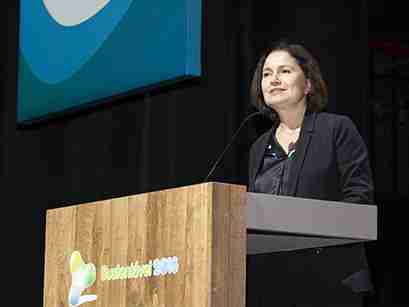
Marina Grossi is president of the Brazilian Business Council for Sustainable Development (CEBDS).

Share:

Sign up for our newsletter

Enter your email and receive our content. We respect the privacy of your information by not sharing it with anyone.

Related news

Check out the most current and relevant news to stay on top of what is being debated on the Sustainable Development agenda.

  • Climate, Energy and Sustainable Finance, Events
  • 03/09/2026

CEBDS Sustainable Congress shows how the climate agenda is already shaping investments, markets, and competitiveness. 

  • Water, Climate, Energy and Sustainable Finance, Agrifood Systems
  • 06/08/2026

A “very strong” El Niño in 2026: what are the risks for Brazil and why should the business sector pay attention?

  • Climate, Energy and Sustainable Finance
  • 11/06/2026

World Cup and Sustainability: What do they have in common?

View more

Related publications

Want to go deeper into this subject? Check here other publications related to this same theme.

IFRS S1 and S2 Guide in Practice
Climate, Energy and Sustainable Finance
  • Climate, Energy and Sustainable Finance
Learn more
  • October 1, 2026

IFRS S1 and S2 Guide in Practice

Playbook: Sectoral Business Coalitions for Climate Action Scaling a Proven Model Across the Globe
Climate, Energy and Sustainable Finance, Coalitions
  • Climate, Energy and Sustainable Finance, Coalitions
Learn more
  • September 22, 2026

Playbook: Sectoral Business Coalitions for Climate Action Scaling a Proven Model Across the Globe

Initial Contributions of the CEBDS Decarbonization Coalitions to the Regulation of the Carbon Market in Brazil
Climate, Energy and Sustainable Finance
  • Climate, Energy and Sustainable Finance
Learn more
  • April 15, 2026

Initial Contributions of the CEBDS Decarbonization Coalitions to the Regulation of the Carbon Market in Brazil

Guide for CFOs: A decade of evolution and innovation in the Brazilian sustainable bond market.
Climate, Energy and Sustainable Finance
  • Climate, Energy and Sustainable Finance
Learn more
  • December 19, 2025

Guide for CFOs: A decade of evolution and innovation in the Brazilian sustainable bond market.

View more

related events

Check out our upcoming events related to this topic and join us to discuss and share best practices.

View more

THEME CHAMBERS
AND WORK GROUPS

Climate, Energy and Sustainable Finance

Biodiversity and Biotechnology

Amazon

Social Impact

Agrifood Systems

Water

Advocacy

Circular Economy


INITIATIVES

Agrifood Chains

Biodiversity Commitment

Water Security Commitment

COPs

IBNBIO

Business Movement for the Amazon

Action Platform for Nature

Net Zero Platform


ABOUT

CEBDS

Timeline

Vision, mission and principles

WBCSD

how we act

CEBDS advice

Team

Associated companies


CONTENTS

Publications

News

Events

Press


INTEGRITY

code of Conduct

Reporting Channel


CONTACT

+55 21 2483-2250

cebds@cebds.org

CEBDS RJ: São José Street, 40, 3rd Floor. Downtown, Rio de Janeiro, RJ.

CEBDS SP: R. Dr. Virgílio de Carvalho Pinto, 445, 3rd floor Pinheiros, São Paulo, SP.

FOLLOW US

Linkedin Facebook X-twitter youtube Instagram Spotify

BE A MEMBER

Join over 100 business groups working together to accelerate the transition to a sustainable future.

Read more

SUBSCRIBE TO THE NEWSLETTER

Enter your email and receive our content. With this, you authorize the capture, storage and use of data provided in campaigns to disseminate CEBDS publications, events and news by email. Unsubscribing can be requested at any time via descadastro@cebds.org.

Privacy Notice

Terms of use

Cookie Policy

CEBDS. All rights reserved. Copyright 2023© – Produced by Ludus and developed by webinhood.