Ir para o conteúdo
  • Press
  • Contact
  • en_US
  • pt_BR
Menu
  • en_US
  • pt_BR
  • About
    • who we are
    • CEBDS
    • Timeline
    • Vision, mission and principles
    • About WBCSD
    • who is part
    • Team
    • Governance
    • Work with us
    • Our Work
    • Thematic Chambers and Working Groups
    • Advocacy
    • Events
    • Initiatives
    • Training
  • Initiatives
    • Thematic Chambers and Working Groups
    • Climate
    • Energy
    • Biodiversity and Biotechnology
    • Sociobioeconomics
    • Social Impact
    • Agrifood Systems
    • Sustainable Finance
    • Water
    • Advocacy
    • Circular Economy
    • initiatives
    • Coalitions for Decarbonization
    • Net Zero Platform
    • Brazil of Solutions
    • Action Platform for Nature
    • Biodiversity Commitment
    • Water Security Commitment
    • UK Pact
    • Vision 2050
    • IBNBIO
    • Business Movement for the Amazon
  • Content Center
    • press
    • Clipping
    • releases
    • Spokespeople
    • Publications
    • Documents
    • News
    • Articles
  • News
  • Associates
  • Events
  • COP31
Pesquisar
Close this search box.
join
  • Climate, Energy and Sustainable Finance, Agrifood Systems

Innovation and sustainability are ways to guarantee global food, say companies in the sector

  • Posted in 27/06/2019

Innovation is the main way to ensure food availability in a scenario that predicts population growth of 26% by 2050. This is the conclusion reached by the leader of Bayer's Crop Science division, Gerhard Bohne, who pointed to the integration between the links in the food chain as the main challenge to ensure sufficient supplies to feed the world's population. Bohne emphasizes that the sector has been working in recent years to develop technologies that guarantee greater productivity aligned with more sustainable production.

“Innovation is essential for the food system. We must increasingly develop customized solutions to ensure that we will be able to feed almost 10 billion people in 2050. To do this, we need to harmonize production, distribution and consumption,” he emphasizes.

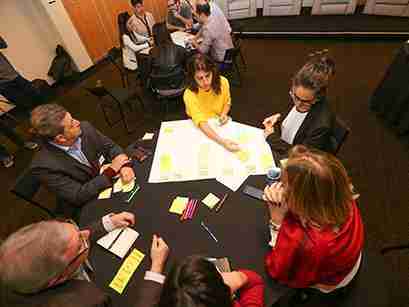
Bohne participated this Thursday (27/06) in the Resilient Food Workshop, promoted by the Brazilian Business Council for Sustainable Development (CEBDS) that brought together actors from various links in the food chain in the country. The workshop is part of the Agroclimatic Intelligence (IAC) program, which aims to increase food availability by 50%, while reducing greenhouse gas emissions by 50%.

The agribusiness chain is currently the largest emitter of GHGs and at the same time the activity most susceptible to climate change. CEBDS's Director of Institutional Development, Ana Carolina Szklo, warns that climate change is an unprecedented challenge, especially for a sector so closely linked to the climate.

“Today, 40% of the land used in the world is used for agribusiness. This is equivalent to 30% of global emissions and 70% of water consumption. We urgently need to make the chain more resilient. Our future depends on the ability to create food systems to guarantee the nutrition of the population”, he states.

Climate change not only affects production capacity, but, according to the Director of Communication and Government Relations at DSM Latam, Zenaide Guerra, it is causing nutritional damage to food. For Zenaide, waste needs to be tackled urgently.

“Of food production intended for human consumption, around 30% is wasted. This accounts for 8% of greenhouse gases and 20% of water used in agriculture. Waste is real and causes serious harm to human beings. We have to be able to understand the local cultures of each country and fortify the basic foods of these diets”, he believes.

Understanding the impact of the chain is one of the ways to make it more resilient. “The climate change process involves a major discussion about access to information. Armed with data, consumers will be able to make more sustainable choices,” says Juliana Lopes, sustainability director at Amaggi.

Another approach is the application of disruptive technologies, such as integrated crop, livestock and forestry (ILPF). This method, which provides for integrated production, increases production per hectare while reducing emissions. The application of this technique faces several barriers: technical assistance and access to credit.

Renato Rodrigues, president of the ILPF network, highlights that, in Brazil, the areas using ILPF techniques jumped from two million hectares in 2005 to 15 million in 2018. The expectation is that, by 2030, 35 million of hectares are applying the technology.

“ILPF is a complete technology. Through it we were able to achieve the goals of the low carbon agriculture plan (ABC) ahead of schedule. It is a set of techniques that allows to increase production, guaranteeing the sustainability of agribusiness”.

Share:

Sign up for our newsletter

Enter your email and receive our content. We respect the privacy of your information by not sharing it with anyone.

Related news

Check out the most current and relevant news to stay on top of what is being debated on the Sustainable Development agenda.

  • Climate, Energy and Sustainable Finance, Events
  • 03/09/2026

CEBDS Sustainable Congress shows how the climate agenda is already shaping investments, markets, and competitiveness. 

  • Water, Climate, Energy and Sustainable Finance, Agrifood Systems
  • 06/08/2026

A “very strong” El Niño in 2026: what are the risks for Brazil and why should the business sector pay attention?

  • Climate, Energy and Sustainable Finance
  • 11/06/2026

World Cup and Sustainability: What do they have in common?

View more

Related publications

Want to go deeper into this subject? Check here other publications related to this same theme.

IFRS S1 and S2 Guide in Practice
Climate, Energy and Sustainable Finance
  • Climate, Energy and Sustainable Finance
Learn more
  • October 1, 2026

IFRS S1 and S2 Guide in Practice

Playbook: Sectoral Business Coalitions for Climate Action Scaling a Proven Model Across the Globe
Climate, Energy and Sustainable Finance, Coalitions
  • Climate, Energy and Sustainable Finance, Coalitions
Learn more
  • September 22, 2026

Playbook: Sectoral Business Coalitions for Climate Action Scaling a Proven Model Across the Globe

Initial Contributions of the CEBDS Decarbonization Coalitions to the Regulation of the Carbon Market in Brazil
Climate, Energy and Sustainable Finance
  • Climate, Energy and Sustainable Finance
Learn more
  • April 15, 2026

Initial Contributions of the CEBDS Decarbonization Coalitions to the Regulation of the Carbon Market in Brazil

Traceability of agri-food chains: a strategic imperative.
Agrifood Systems
  • Agrifood Systems
Learn more
  • January 22, 2026

Traceability of agri-food chains: a strategic imperative.

View more

related events

Check out our upcoming events related to this topic and join us to discuss and share best practices.

COP31, Agrifood Systems

Investment in Resilient Supply Chains: Linking Traceability, Emissions, and Finance for Producers

November 16th

Food and Agriculture Pavilion

+ learn more
COP31, Agrifood Systems

From Climate Pathways to Farm-Level Action: Trade, Finance and Agrifood Value Chains

November 16th

Food and Agriculture Pavilion

+ learn more

View more

THEME CHAMBERS
AND WORK GROUPS

Climate, Energy and Sustainable Finance

Biodiversity and Biotechnology

Amazon

Social Impact

Agrifood Systems

Water

Advocacy

Circular Economy


INITIATIVES

Agrifood Chains

Biodiversity Commitment

Water Security Commitment

COPs

IBNBIO

Business Movement for the Amazon

Action Platform for Nature

Net Zero Platform


ABOUT

CEBDS

Timeline

Vision, mission and principles

WBCSD

how we act

CEBDS advice

Team

Associated companies


CONTENTS

Publications

News

Events

Press


INTEGRITY

code of Conduct

Reporting Channel


CONTACT

+55 21 2483-2250

cebds@cebds.org

CEBDS RJ: São José Street, 40, 3rd Floor. Downtown, Rio de Janeiro, RJ.

CEBDS SP: R. Dr. Virgílio de Carvalho Pinto, 445, 3rd floor Pinheiros, São Paulo, SP.

FOLLOW US

Linkedin Facebook X-twitter youtube Instagram Spotify

BE A MEMBER

Join over 100 business groups working together to accelerate the transition to a sustainable future.

Read more

SUBSCRIBE TO THE NEWSLETTER

Enter your email and receive our content. With this, you authorize the capture, storage and use of data provided in campaigns to disseminate CEBDS publications, events and news by email. Unsubscribing can be requested at any time via descadastro@cebds.org.

Privacy Notice

Terms of use

Cookie Policy

CEBDS. All rights reserved. Copyright 2023© – Produced by Ludus and developed by webinhood.