
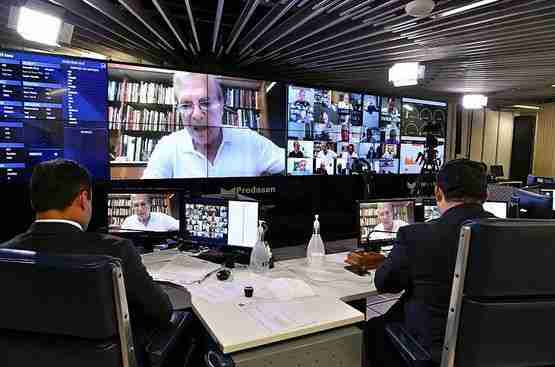
The new legal framework for basic sanitation, approved yesterday in Senate and which is now awaiting presidential sanction, is an opportunity for a sustainable recovery of the economy after the pandemic.
This assessment comes from the president of the Brazilian Business Council for Sustainable Development (CEBDS), Marina Grossi, who has been mobilizing efforts in recent years to make the sector's services universal in Brazil.
“Universalizing sanitation is an urgent issue, with social, environmental and economic impacts. It concerns, for example, public health, life expectancy, education and productivity. We can no longer accept that 19th century problems exist in the 21st century,” says Marina Grossi.
According to a survey by the National Sanitation Information System (SNIS), with Brazil's current pace of investment in the sector, universalization of the service would take more than 40 years to be achieved. As a result, the objective of the National Basic Sanitation Plan (Plansab), to meet this target by 2033, would be significantly behind schedule.
The text approved by the Senate is considered a stimulus for the necessary investments in the sector, since it creates rules for greater participation by the private sector. One of the main sections that deals with the topic, and which is also one of the most controversial, is that which addresses the current program contracts, signed between state water and sewage companies and municipalities.
Program contracts have rules for provision and pricing, but allow state-owned companies to take over services without competition. The new framework eliminates this model, transforming it into concession contracts with the private company that takes over the state-owned company, and makes it mandatory to open a bidding process involving public and private companies.
CEBDS and the water and sanitation agenda
The water and sanitation sector was one of the topics covered in the series of webinars that are part of ReVisão 2050, which aims to revisit the guidelines for long-term development, launched eight years ago.
“The model will only start to change with the approval of the Bill that is in the Senate. This should be the next priority of the National Congress, because it will allow some ordering for the private sector's access to this type of service”, said Teresa Vernaglia, CEO of BRK Ambiental, at the time.
The executive also assessed that the sector is a potential locomotive for investments in the post-pandemic period, with disbursements of around R$20 billion in infrastructure and the generation of jobs and income.
The webinar resulted in an ebook with the main contributions from the participants, with a diagnosis and possible paths to be followed.
A study by BRK Ambiental and Instituto Trata Brasil directly linked the lack of basic sanitation with lower incomes for Brazilian women. Universal sanitation would generate productivity gains and increased income, allowing more than 635,000 women to escape poverty. In terms of numbers, the average increase in income over the course of a year per Brazilian woman would be R$321.03, a total of R$12 billion per year in terms of income gains.
One of CEBDS's main initiatives to increase private sector participation in the sector was the launch of the Brazilian Business Commitment to Water Security, during the 8th World Water Forum, in March 2018. The more than 20 large business groups that signed the document are committed to developing solutions for better water resource management in their activities, with goals to be achieved by 2025.
Conceived from the pillars Availability, Use and Destination of water, the document establishes six goals:
- Expand the inclusion of the water theme in the business strategy
- Mitigate water risks to the business
- Measure and publicly communicate water management in the company
- Encouraging shared projects in favor of water
- Promote chain engagement
- Contribute with technologies, knowledge, processes and human resources
In addition to gathering contributions from the business sector, the Brazilian Business Commitment for Water Security aims to launch Brazil as a protagonist in the global debate on the topic. The goal is to take these contributions to the next World Water Forum, in Senegal, in 2021.
In the 2018 presidential elections, CEBDS sent candidates the following CEBDS Agenda for a Sustainable Country, with 10 proposals on topics that are relevant for long-term development. In the document, Proposal 8 proposed the revision of the National Basic Sanitation Plan, with the inclusion of reuse as a water efficiency strategy. The proposals were prepared by the CEBDS Leaders Council, a working group formed by executives from companies that account for a turnover equivalent to 45% of the National GDP.
In a webinar held last month by the Council of Leaders, economist Mônica de Bolle defended basic sanitation as a “driving force” for economic recovery in the post-pandemic scenario.
CHECK OUT THE FULL WEBINAR WITH MÔNICA DE BOLLE:
What is the impact of the sanitation framework on the economy?
In health spending alone, universalizing basic sanitation could save R$7.2 billion between 2015 and 2035, due to the reduction in hospitalizations paid for by the Unified Health System (SUS) and absences from work resulting from gastrointestinal infections (Trata Brasil, 2017).
The Trata Brasil survey highlights that universal sanitation would result not only in reduced spending, but also in increased labor productivity and, therefore, in workers' income. The combination of these factors would result in an estimated value of R$82.9 billion,
of which a significant portion would return to the public coffers through taxes and contributions.
Regarding the direct impact on job creation, the National Confederation of Industry (CNI) estimated that the R$3.8 billion investment in sanitation would generate 221,000 jobs. Among other sectors, the construction industry and the machinery and equipment industry would benefit.
In addition to the positive effects already mentioned, the expansion of basic sanitation would also generate income through the appreciation of properties and positive impacts on tourism, environmental preservation and improvements in urban conditions.
From another perspective, the economic benefits of universal sanitation can be measured by the relationship between the amount invested in the sector and its return to the economy. On average, for every R$ 1.00 invested in sanitation, the return to the economy is R$ 1.7038, indicating a very favorable cost-benefit relationship.


