
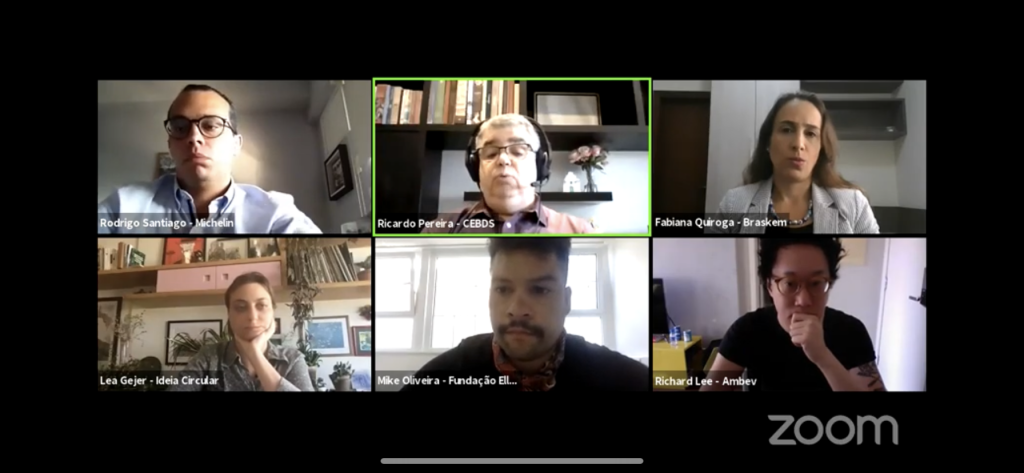
Circular economy experts debate at a CEBDS event how the concept, central to European recovery plans from an environmental perspective, can be business opportunities in Brazil
Rio de Janeiro, July 22, 2020 – Convincing consumers to pay more for a product with a lower environmental impact could be a viable reality in the European Community, which is launching its “Green Deal”, basing the post-pandemic business resumption on pillars such as the circular economy, aimed at reducing emissions that cause climate change and reducing the consumption of natural resources. But in developing countries, the simplest solutions, such as the return of returnable beverage packaging, or the bulk sale of cleaning products, cultures abandoned generations ago, can be easy and more viable solutions to include the low-income population in this effort. towards sustainable development.
This social inclusion, as well as the need to share solutions between companies, and the adoption of public policies favorable to the environment and to protect vulnerable links in production chains, were the main points highlighted by representatives of companies and institutions specializing in the subject of economics. circular, during an online event promoted by the Brazilian Business Council for Sustainable Development (CEBDS), this Wednesday (22), within the ReVisão 2050 series, which aims to think about sustainable and long-term planning for the post-pandemic world.
“Covid highlighted inequalities and vulnerabilities, but it also shed light on opportunities for reconstruction. If, on the one hand, the crisis hit small and medium-sized businesses hardest, we also saw many people turning to agroecology, peri-urban food production, and small organic farming businesses. We cannot lose sight of the fact that talking about a circular economy in Latin America means talking about social insertion and the challenges of vulnerability”, highlighted Mike Oliveira, coordinator of Systemic Initiatives for Latin America at the Ellen MacArthur Foundation, an institution that is one of the main references on the topic in the world.
For Richard Lee, head of Sustainability of the Ambev Brewery, in addition to social inclusion to be promoted with solutions that are easy to assimilate and low cost for the consumer, it is necessary to think about inclusion throughout the chain. He highlights that during the quarantine, thousands of collectors were affected. “The pandemic revealed how poorly protected the links in this chain were. They were and remain helpless. They are on the street, handling waste that may be contaminated and without adequate equipment. Furthermore, they work in areas where income has fallen, such as restaurants and bars, and they were unable to stay at home because they had no income. If companies were not ready for the pandemic, they were even less ready to support these vulnerable people. As the months went by, many companies organized themselves to donate, but they still fell far short of what was necessary,” he said, highlighting that it is important to make joint efforts not only to create marketplace between companies, but to shield the weakest links in the business chain.
According to research by the National Confederation of Industry (CNI), more than 70% of Brazilian companies recognize the importance of adopting the circular economy methodology in their production processes, but the same percentage still do not know how to do it. Much of it still focuses only on waste treatment or reverse logistics issues, but the concept goes much further, explains specialist Lea Gejer, founder of Ideia Circular: “The concept Cradle to Cradle, or 'from cradle to cradle' ties two spheres. The biosphere and the technosphere. In the first one we consider everything that can return to the earth, such as food. In the second are the materials, which must have their parts reused for other uses without being discarded. But for this cycle to work, we cannot just think about the final waste, but about all stages of production, including architecture and design, and the use of raw materials. This requires a practical transformation of all links in the chain.”
The transformation of the links in the production chain to a circular economy involves three pillars, in the opinion of Braskem's director of Recycling and Wecycle Platform, Fabiana Quiroga: 1) Investment by companies in innovation, in search of efficiency in production processes and to find new ones products aligned with the circular and regenerative concept; 2) creation of an effective regulatory and tax framework; and 3) consumer awareness about use and disposal. “It is necessary to invest in education to implement new habits for consumers, because it seems counter-intuitive, but the recycling industry currently has a lack of material, while many reusable products fill landfills”, he argued.
“Currently in the world only 8.6% of the economy is circular. We consume 100 billion tons of materials per year, a record. Therefore, the model has to be rethought, at the risk of depleting natural resources and accelerating climate change, if this unbridled use continues”, said the director of Technical Development at CEBDS, Ricardo Pereira, highlighting that the circular economy, that is, the replacement The standard of an economy based on linearity (extraction, consumption, disposal) is one of the main pillars for the new low-carbon economy.
Among the main opportunities highlighted by experts that arise from Covid and the green recovery is the fact that Brazil has complete production chains in the country, which puts it at an advantage to close the sustainable cycle of this economy, without depending on globalized negotiations. “We have great competitive advantages and we have to think about global value issues. In the pandemic, we saw our weaknesses in relation to some very simple supply chains, like masks, for example, but we have complete chains here, between textiles, food, construction. It is necessary to rethink Brazil's reinsertion into large value chains, valuing these assets”, argued Rodrigo Santiago, director of Institutional Relations at Michelin.
ABOUT CEBDS
The Brazilian Business Council for Sustainable Development (CEBDS) is a non-profit civil association that promotes sustainable development through coordination with governments and civil society, in addition to disseminating the most current concepts and practices on the topic. Founded in 1997, it brings together around 60 of the largest business groups in the country, responsible for more than 1 million direct jobs. Represents the network of World Business Council for Sustainable Development (WBCSD), which has almost 60 national and regional councils in 36 countries and 22 industrial sectors, in addition to 200 business groups operating on all continents.
With the coronavirus crisis, CEBDS is holding discussions among its member companies and multisector experts on the resumption of business and long-term planning, revisiting the commitments defined in the Vision Brazil 2050 document, launched at Rio+20 in 2012. The last event in the series takes place on August 5th and will deal with cities.
More information: https://cebds.org/
PRESS CONTACTS
eduardonunes@altercomunicacao.com.br | +55 21 99864.4245
Eduardo Nunes
debora@altercomunicacao.com.br | +55 21 98751-4902
Deborah Rolando


