
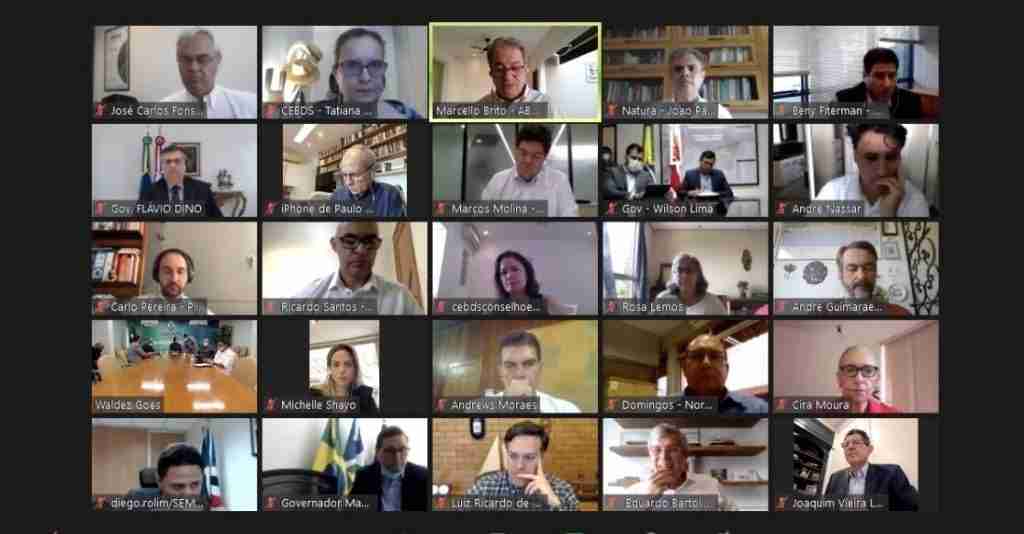
In a meeting with the Amazon Consortium, a business movement for sustainability advocates the implementation of the Forest Code and suggests establishing targets for deforestation, land regularization and the evolution of the region's GDP
Rio de Janeiro, August 12, 2020 – Assessment and validation of the Rural Environmental Registry, aiming to accelerate this process for the implementation of the Forest Code; power (police action) in the fight against organized crime linked to land grabbing and illegal deforestation, which harms legal businesses in the Amazon; greater integration between land institutes and INCRA in the creation of collaborative governance that speeds up land regularization processes; and improvement of infrastructure and governance in the analysis and granting of environmental licenses.
These are objective actions that were presented this Wednesday to the governors of the Amazon Consortium by the coordinating institutions (CEBDS, ABAG, IBÁ, ABIOVE and Rede Brasil do Pacto Global) of Notice from the Brazilian Business Sector, launched last July. The meeting brought together leaders of the business movement for sustainability with the 9 governors of the states of the Legal Amazon (Rondônia, Acre, Amazonas, Roraima, Pará, Amapá, Tocantins, Mato Grosso and Maranhão).
“We need to work to develop the Amazon, preserving and exploring the potential of the region’s bioeconomy,” said Marcello Brito, president of the Brazilian Agribusiness Association (ABAG). “It is very clear to the Brazilian productive sector that more needs to be done to combat illegal deforestation in the Amazon. And we are particularly concerned about the negative perception of Brazil’s image abroad,” said Marina Grossi, president of the Brazilian Business Council for Sustainable Development (CEBDS).
The governor of Amapá and president of the Interstate Consortium for Sustainable Development of the Legal Amazon, Waldez Góes, acknowledged the image problem and said that the states are committed to the environmental agenda. “We need to build partnerships. The more we integrate our efforts, the greater the visibility of the positive agenda,” he said.
Marfrig’s Chairman of the Board, Marcos Molina, highlighted the decision by supermarket chain Tesco, the largest supermarket chain in the United Kingdom, to remove Brazilian meat from its shelves due to deforestation in the Amazon. “We need to act quickly and traceability is a way to show that we are doing the right thing,” said the executive. Vale CEO Eduardo Bartolomeo suggested establishing effective deforestation targets with state governments and alignment and integration with the federal government.
For Natura CEO João Paulo Ferreira, defining deforestation targets, land regularization and increasing the GDP of the Amazon Consortium itself, for example, could also contribute to dialogue with international investors. Agropalma CEO Beny Fiterman said he expects more forceful action to combat deforestation. “Today, there is a lack of legal certainty in the Amazon,” he said. Also participating in the meeting were Norsk Hydro’s Sustainability Director Domingos Campos and Alcoa’s Director of Government Relations and Communications Michelle Shayo.
In their speeches, the governors reaffirmed their commitment to the environmental agenda and highlighted projects and solutions that can contribute to this agenda. “We need to put a price on the value of standing forests. Preserving the forest can be more profitable than a hectare of soybeans or pasture. It needs to be monetized,” argued the governor of Pará, Helder Barbalho. “We need to mobilize resources to develop projects, such as those of the Amazon Fund, for example, which are stagnant. There is also a fund that the vice president of the Republic (Hamilton Mourão) has committed to leveraging together with companies and the IDB,” said the governor of Maranhão, Flávio Dino.
The governor of Mato Grosso, Mauro Mendes, emphasized the importance of combating illegal deforestation, the governor of Roraima, Antonio Denarium, highlighted simplified environmental licensing, and the governor of Tocantins, Mauro Carlesse, highlighted the potential for integrated actions between the government and the private sector. Representatives from the governments of Acre, Amazonas and Rondônia also participated in the meeting.
PRESS CONTACTS
eduardonunes@altercomunicacao.com.br | +55 21 99864.4245
Eduardo Nunes


