
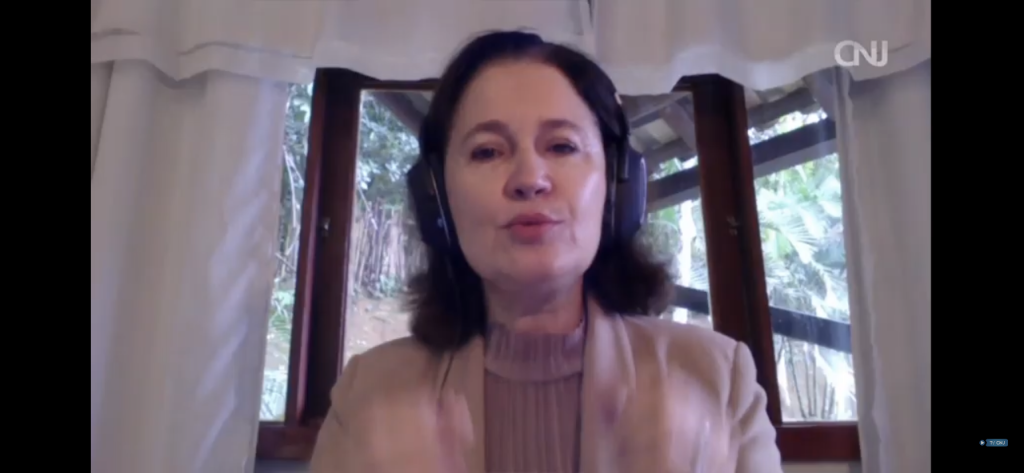
CEBDS president, Marina Grossi, participated today in the Public Hearing “Agenda 2030” of the National Council of Justice. In her speech, Marina highlighted that Brazil can conserve and produce at the same time, and that the new economy is necessarily decarbonized.
Illegal deforestation was one of the points highlighted by the president of CEBDS. It is important to emphasize that the illegal and systematic deforestation of the Amazon is a violation of the constitution and favors those who act under the cover of the lack of punishment. Since 1985, Brazil has lost 89 million hectares of native areas, equivalent to 3.6 times the area of the state of São Paulo.
“Deforestation benefits a small criminal group, and it needs to be combated with great force. Integration is important. My suggestion is that we move forward on the issue of deforestation with targets and signaling that the situation will change. This will place Brazil as a protagonist in the application of nature-based solutions,” said Marina Grossi.
After more than a decade in which we managed to reduce deforestation, we have seen unbridled growth since 2012, with a clear trend of constant growth in deforestation. The accumulated total for the first four months of 2020, according to the SAD (Deforestation Alert System), was 1,703 km², an area larger than the city of São Paulo (1,521 km²) and a number 133% higher than the same period in 2019, when the system recorded deforestation of 460 km².
From August 2019 to July 2020, growth was 34% compared to the same previous period, according to data from the National Institute for Space Research, INPE, the data from July show considerable destruction in the biome: more than 1,500 km² were devastated in 30 days.
“There is no marketing that can solve the issue of deforestation if we do not have specific measures against deforestation. We must join forces so that we can contribute data that results in specific goals,” said Marina Grossi.
It is possible to produce and preserve
For the Brazilian business sector, producing and preserving are not antagonistic verbs, which is why we launched the Brazilian business sector statement on July 7, signed by 42 leaders of companies and institutions.
This is an open document, which currently has 76 signatures, including five national investment funds. Brazil knows that most deforestation is illegal, carried out by a small group of people. Therefore, it is very clear to the Brazilian productive sector that more needs to be done to combat illegal deforestation in the Amazon.
We understand that the Brazilian government needs to quickly implement effective measures to combat illegal deforestation in the country. This necessarily involves strengthening environmental agencies and also expanding inspection teams.
In the statement, the business sector recalls that some of the signatory companies already develop business solutions that start from the bioeconomy, with added value and traceability of products, including in the Amazon.
In addition to the effective fight against illegal deforestation, the document highlights the following as priority focuses for action: (i) social and economic inclusion of local communities to guarantee the preservation of forests; (ii) minimization of the environmental impact in the use of natural resources, seeking efficiency and productivity in the economic activities derived therefrom; (iii) valorization and preservation of biodiversity as an integral part of business strategies; (iv) adoption of carbon credit trading mechanisms; (v) directing financing and investments towards a circular and low-carbon economy; and (vi) incentive packages for economic recovery from the effects of the COVID-19 pandemic, conditioned on a circular and decarbonized economy.
The document ends with a message of optimism, remembering that Brazil has the unique opportunity, the resources, and the knowledge to scale up good practices and, more than that, strategically plan the country's sustainable future. And it is necessary to redirect investments to confront and recover the Brazilian economy in a circular, low-carbon, and inclusive economy model.
“Large companies operate in the Amazon. And these CEOs signed the statement saying that no more illegal deforestation can happen. We must have effective action from the judiciary. We started by presenting the statement to the Vice President of the Republic, Hamilton Mourão, then to the President of the Chamber of Deputies, Rodrigo Maia. Then to the President of the Supreme Federal Court, Dias Toffoli, and today we will speak with Augusto Aras, Attorney General of the Republic,” said Marina Grossi.
To know the signatories and the document access here.
Companies and sustainable development in the Amazon
Some of the large companies with a presence and operations in the Amazon have been presenting solutions and business models that are based on the bioeconomy and that should be in force in a society that demands greater added value to the product, including reliable traceability:
Natura
It works with local communities in the Amazon to make its cosmetics base world-renowned. The Ekos project values local environmental assets and creates income-generating mechanisms for the so-called “guardians of the forest”. Natura buys almost a fifth of its inputs from the Amazon region and aims to reach 30%. Despite all the difficulties, which are not only logistical, the project serves more than 4,600 families and preserves 1.8 million hectares.
Ambev
It has been operating for over 100 years in the municipality of Maués, in the Amazon, also known as the land of guarana. The company consumes 100% of the fruit used in the production of guarana antartica harvested in the city, with over 80% from local producers, who receive seedlings produced on a farm owned by the company itself. Even preserving 80% of the farm, the production of the fruit has grown by 140% in the last decade. Ambev has benefited two thousand local families with 100% of manual work. The company works with the community through social and training activities, sharing techniques. In addition, it distributes 50 thousand guarana seedlings to 150 families annually. The impact reverberates and, in two years, it was possible to promote 52% of increase in the income of local producers.
Votorantim Cimentos
Based on the maxim “from trash to treasure”, Votorantim Cimentos creates value for açaí, a typical fruit of the region. Composed of 80% of pit, previously discarded in quantities of over 300 thousand tons, açaí was recognized for its caloric value in the company’s furnaces. The pit, processed in the region, replaces the coke that travels over 10 thousand kilometers to reach the Primavera unit in Pará. The use of the local product, in addition to reducing direct emissions, also reduces the gases emitted during transportation. One of the levers for reducing emissions in the cement sector is the replacement of fossil fuels. Today, 40% of the energy in Primavera is supplied with açaí bagasse. In 2018 alone, the cement company avoided the direct emission of 117 thousand tons of carbon. If indirect emissions are added, another 200 thousand tons of carbon were avoided in the atmosphere.


