Launched this Tuesday (18) in Brazil, a global initiative aims to bring together companies around actions aimed at reversing biodiversity losses by 2030
Rio de Janeiro, August 18, 2020 – The business world launched this Tuesday, 18/08, in Brazil the initiative Call to Action (Call to Action), which aims to bring together companies from all over the world around actions aimed at reversing biodiversity losses by 2030 through economic and financial transformations. Organized by Business for Nature, a global coalition focused on business integration and nature preservation, the initiative in Brazil is led by the Brazilian Business Council for Sustainable Development (CEBDS), The Nature Conservancy (TNC), WWF and the International Chamber of Commerce in Brazil (ICC Brasil) and already has the membership of around 30 large companies operating in Brazil, such as Anglo American, BRK Ambiental, Carrefour, Danone, Eletrobrás, Natura and Suzano .
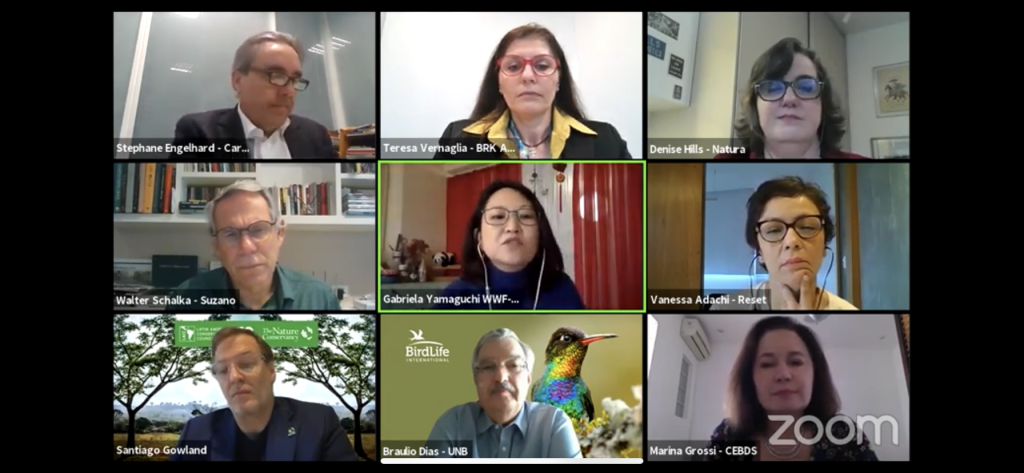
The launch took place this Tuesday morning in the webinar 'Building resilience in business', which brought together experts and business leaders. “This is an opportune moment to chart a better path to recovery from this crisis, aiming to guarantee the development of a low-carbon, more resilient and sustainable economy,” said Marina Grossi, president of CEBDS, at the opening of the webinar. “We are in the decade of actions. Until 2030, our commitments are ambitious and we need to act now if we want to promote transformation with scale, impact and social prosperity”, said Gabriela Yamaguchi, director of Engaged Society at WWF Brazil.
Moderator of the debate, Bráulio Dias, professor at the University of Brasília and former executive secretary of the Convention on Biological Diversity (CBD), highlighted some data on biodiversity loss. Around the world, around one million animal and plant species are currently threatened with extinction. More than 40% of amphibian species, nearly 33% of reef-building corals, and more than a third of all marine mammals are endangered. “We run the risk of the planet’s degradation reaching the point of no return,” warned Dias, who today presides over the NGO BirdLife International.
“This initiative has a lot to do with BRK’s business, which is a private sanitation company. Our main input is water”, commented Teresa Vernaglia, CEO of BRK Ambiental, highlighting the importance for the business of investing in environmental preservation and reducing waste in the distribution network. “Today, there is tremendous inefficiency, with around 40% of treated water being lost in the distribution network. Furthermore, there is the challenge of sewage treatment. Today, Brazil dumps around 6,000 Olympic-sized swimming pools of raw sewage per day into its rivers, lagoons, seas…”, added the executive.
Suzano's CEO, Walter Schalka, drew attention to the urgency of the actions. “We have to transform now,” said the executive, highlighting the company’s goals in the tree sector planted in Brazil. “We are already carbon negative. But we have set a new target of sequestering 40% of carbon by 2030. In expanding the forest base and reducing consumption in our operations”, explained Schalka. According to him, Suzano also plans to replace 10 million tons of plastic by 2030 and remove 200,000 people from the poverty line in the communities where the company operates, through education and local income generation.
Natura's Director of Global Sustainability, Denise Hills, presented the Brazilian company's experience of 20 years of operation in the Amazon and highlighted the commitment to eliminate deforestation in the biome by 2025. “We need to guarantee the preservation of one of the richest forests in biodiversity in the world. world and our experience shows that the development of value chains is an assertive strategy”, suggested the executive.
Carrefour's vice-president of institutional relations, Stéphane Engelhard, recalled the consumer's increasing influence on business decisions and pointed to traceability as an efficient instrument for monitoring and controlling production. “Consumers play a decisive role because they increasingly value social and environmental issues. How can we ensure that our products respect the environment and social issues, such as those related to slave labor, for example? Traceability is a tool that can support this process”, said Engelhard.
Also participating in the webinar were Gabriella Dorlhiac, executive director of ICC Brazil, who highlighted the need for strong actions to contain the loss of biodiversity, and Santiago Gowland, executive vice-president of Latin America and Global Innovation at The Nature Conservancy, as well as journalist Vanessa Adachi , who helped moderate the discussion. Companies interested in being part of the CTA can sign up until September 1st, regardless of size or area of activity on the website. https://www.businessfornature.org/call-to-action.
ABOUT CEBDS
The Brazilian Business Council for Sustainable Development (CEBDS) is a non-profit civil association that promotes sustainable development through articulation with governments and civil society, in addition to disseminating the most current concepts and practices on the subject. Founded in 1997, it brings together around 60 of the largest business groups in the country, responsible for more than 1 million direct jobs. It represents in Brazil the network of the World Business Council for Sustainable Development (WBCSD), which has almost 60 national and regional councils in 36 countries and 22 industrial sectors, in addition to 200 business groups that operate in all continents. More information: https://cebds.org/.
PRESS CONTACTS
CEBDS
eduardonunes@altercomunicacao.com.br | +55 21 99864.4245
Eduardo Nunes