Ir para o conteúdo
  • Press
  • Contact
  • en_US
  • pt_BR
Menu
  • en_US
  • pt_BR
  • About
    • who we are
    • CEBDS
    • Timeline
    • Vision, mission and principles
    • About WBCSD
    • who is part
    • Team
    • Governance
    • Work with us
    • Our Work
    • Thematic Chambers and Working Groups
    • Advocacy
    • Events
    • Initiatives
    • Training
  • Initiatives
    • Thematic Chambers and Working Groups
    • Climate
    • Energy
    • Biodiversity and Biotechnology
    • Sociobioeconomics
    • Social Impact
    • Agrifood Systems
    • Sustainable Finance
    • Water
    • Advocacy
    • Circular Economy
    • initiatives
    • Coalitions for Decarbonization
    • Net Zero Platform
    • Brazil of Solutions
    • Action Platform for Nature
    • Biodiversity Commitment
    • Water Security Commitment
    • UK Pact
    • Vision 2050
    • IBNBIO
    • Business Movement for the Amazon
  • Content Center
    • press
    • Clipping
    • releases
    • Spokespeople
    • Publications
    • Documents
    • News
    • Articles
  • News
  • Associates
  • Events
  • COP31
Pesquisar
Close this search box.
join
  • Carbon Market

Adopting long-term strategies can contribute to decarbonizing countries

  • Posted in 23/08/2019

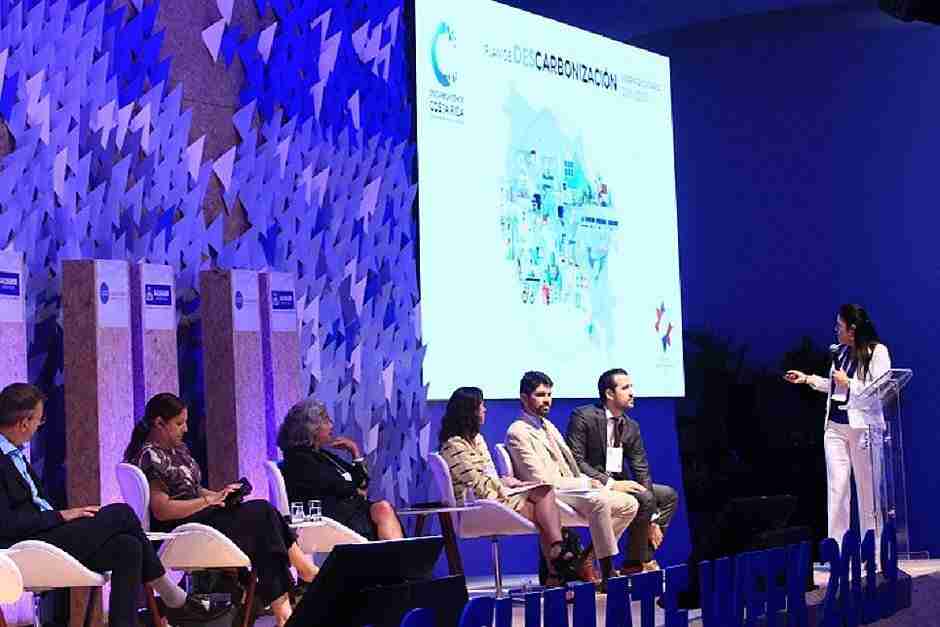
The conclusion was reached during the plenary session "Long Term and Decarbonization," held on the fourth day of the Latin American and Caribbean Climate Change Week. The session began with a minute of silence for the Amazon fires, which have already consumed 21,000 hectares of forest.

The head of Climate Change at Inter-American Development Bank (IDB), Amal Lee Amin spoke about the bank's work through a decarbonization platform. According to the expert, the planet needs to be carbon neutral between 2050 and 2070 to keep global warming limited to 1.5°C, as recommended by the IPCC for global safety.

"A carbon-neutral world is possible by following five pillars: decarbonizing electricity generation, electrifying the fleet, improving the public transportation system, zeroing net deforestation and reforestation, and reducing waste. It's necessary to establish a clear vision that a low-carbon future brings economic benefits to all," he argued.

The statement was echoed by Patrícia Campos, a representative of Costa Rica's Ministry of the Environment. She believes it's necessary to quantify the benefits of decarbonization, such as reduced healthcare costs, reduced traffic jams and accidents, reduced fossil fuel imports, and a revitalized domestic economy. Costa Rica and Chile are the first countries in Latin America and the Caribbean to commit to becoming carbon neutral by 2050.

"Decarbonization cuts across all sectors of the country and is part of the development plan. We work with several strategies, including education and culture, institutional reform, and a just transition."

Ivan Dario, from the Colombian Ministry of the Environment, said that the Paris Agreement and the Sustainable Development Goals (SDGs) are guiding principles in developing the country's long-term strategy.

"We're already beginning to feel the effects of climate change, which are affecting our coffee production. That's why it's crucial to have government support, working together with various sectors: academia, the private sector, experts, and civil society."

Representative of the German Environment Agency, Benno Hain, reinforced that the country continues to support Latin America and the Caribbean in their efforts to mitigate and adapt to climate change and made a mea culpa.

"We are aware that we need to increase the ambition of our NDC. The process of achieving decarbonization by 2050 is being done in a participatory manner."


Brazilian business sector and long-term strategies

CEBDS's Director of Technical Development, Ana Carolina Szklo, spoke about the Brazilian business sector's experience in building long-term strategies. Ana emphasized that it was first necessary to engage with companies to understand the risks and opportunities of the Brazilian NDC. "After understanding the scenarios, we discussed how to build a long-term business strategy. Subsequently, we conducted a Vision 2050 study that addresses the world we want. This study is currently being revisited, and to achieve this, we are developing an inclusive process, considering all regions of the country and guided by science."

Learn about the study CEBDS's long-term low-carbon development strategy.


Photo Credits: Correio24horas

Share:

Sign up for our newsletter

Enter your email and receive our content. We respect the privacy of your information by not sharing it with anyone.

Related news

Check out the most current and relevant news to stay on top of what is being debated on the Sustainable Development agenda.

  • Advocacy, Climate, Energy and Sustainable Finance, Carbon Market
  • 25/06/2024

Carbon market: deputy receives position due to urgency in regulation

  • Climate, Energy and Sustainable Finance, Carbon Market
  • 05/06/2024

CEBDS and 52 large associated companies sign a letter of urgency to create a regulated carbon market  

  • Advocacy, Water, Amazon, Biodiversity and Biotechnology, Climate, Energy and Sustainable Finance, Carbon Market
  • 07/03/2024

G20: CEBDS represents business sector in task forces

View more

Related publications

Want to go deeper into this subject? Check here other publications related to this same theme.

Leading the Transition to a Low-Carbon Future
Carbon Market
  • Carbon Market
Learn more
  • December 9, 2025

Leading the Transition to a Low-Carbon Future

Integrating Regulated Carbon Markets: A Strategic Role for the Business Sector
COP30, Carbon Market
  • COP30, Carbon Market
Learn more
  • November 14, 2025

Integrating Regulated Carbon Markets: A Strategic Role for the Business Sector

Positioning of the Brazilian business sector due to the urgency of creating a regulated carbon market in Brazil
Climate, Energy and Sustainable Finance, Carbon Market
  • Climate, Energy and Sustainable Finance, Carbon Market
Learn more
  • June 5, 2024

Positioning of the Brazilian business sector due to the urgency of creating a regulated carbon market in Brazil

Reporting Matters Brasil 2023 report
Advocacy, Water, Amazon, Biodiversity and Biotechnology, Climate, Energy and Sustainable Finance, Impact…
  • Advocacy, Water, Amazon, Biodiversity and Biotechnology, Climate, Energy and Sustainable Finance, Social Impact, Carbon Market, Reporting Matters
Learn more
  • January 29, 2024

Reporting Matters Brasil 2023 report

View more

related events

Check out our upcoming events related to this topic and join us to discuss and share best practices.

View more

THEME CHAMBERS
AND WORK GROUPS

Climate, Energy and Sustainable Finance

Biodiversity and Biotechnology

Amazon

Social Impact

Agrifood Systems

Water

Advocacy

Circular Economy


INITIATIVES

Agrifood Chains

Biodiversity Commitment

Water Security Commitment

COPs

IBNBIO

Business Movement for the Amazon

Action Platform for Nature

Net Zero Platform


ABOUT

CEBDS

Timeline

Vision, mission and principles

WBCSD

how we act

CEBDS advice

Team

Associated companies


CONTENTS

Publications

News

Events

Press


INTEGRITY

code of Conduct

Reporting Channel


CONTACT

+55 21 2483-2250

cebds@cebds.org

CEBDS RJ: São José Street, 40, 3rd Floor. Downtown, Rio de Janeiro, RJ.

CEBDS SP: R. Dr. Virgílio de Carvalho Pinto, 445, 3rd floor Pinheiros, São Paulo, SP.

FOLLOW US

Linkedin Facebook X-twitter youtube Instagram Spotify

BE A MEMBER

Join over 100 business groups working together to accelerate the transition to a sustainable future.

Read more

SUBSCRIBE TO THE NEWSLETTER

Enter your email and receive our content. With this, you authorize the capture, storage and use of data provided in campaigns to disseminate CEBDS publications, events and news by email. Unsubscribing can be requested at any time via descadastro@cebds.org.

Privacy Notice

Terms of use

Cookie Policy

CEBDS. All rights reserved. Copyright 2023© – Produced by Ludus and developed by webinhood.